AEO vs SEO: what's different, and do you need both?
AEO wins the cited answer inside AI assistants; SEO wins the ranking in a list of links. Here's how they differ, where they overlap, and how to run both.
SEO wins a ranking in a list of links; AEO wins a citation inside a single AI answer. They share a foundation (crawlable, authoritative, well-structured content) but reward different things: SEO rewards keywords and links, AEO rewards extractable declarative content, schema and authority on the sources models cite. AEO is a layer you add on top of SEO, not a replacement.
- SEO and AEO have the same goal (be found) on two surfaces: a list of links vs a single synthesized answer.
- SEO rewards keywords, backlinks and rankings. AEO rewards extractable, declarative content, schema, and authority on the sources models cite.
- They share a foundation: crawlable, authoritative, topically deep content helps on both surfaces.
- AEO is not replacing SEO. It is a layer you add on top of a working SEO base.
- You measure them differently: SEO by rankings and clicks, AEO by citation rate and share of voice across engines.
AEO and SEO chase the same goal, being found, on two different surfaces. SEO (search engine optimization) competes for a ranking in a list of links. AEO (answer engine optimization) competes for a citation inside a single AI-generated answer. The confusion comes from treating them as rivals. They are layers: AEO is the new one you add on top of a working SEO base, and the buyers who now ask AI assistants their questions are what make that layer decisive.
This guide covers what each one optimizes for, where they overlap, when each matters, and how to run both without doing double the work. (If you use the term GEO instead of AEO, the same analysis applies, they are near-synonyms, see AEO vs GEO.)
The core difference: a list of links vs a single answer#
The clearest way to see the difference is to watch the same question resolve on each surface.
Search a query on Google and you get a results page: ten blue links, ads, and features, and you, the human, still do the work of clicking, comparing and deciding. SEO’s job is to win a high position in that list so you get the click.
Ask the same question in ChatGPT or Perplexity and you get one synthesized answer: a recommendation, often a short list of named products, with a handful of inline citations. The assistant has already done the comparing. AEO’s job is to make sure your brand is inside that answer, cited and recommended, not left out of a verdict the buyer takes at face value.
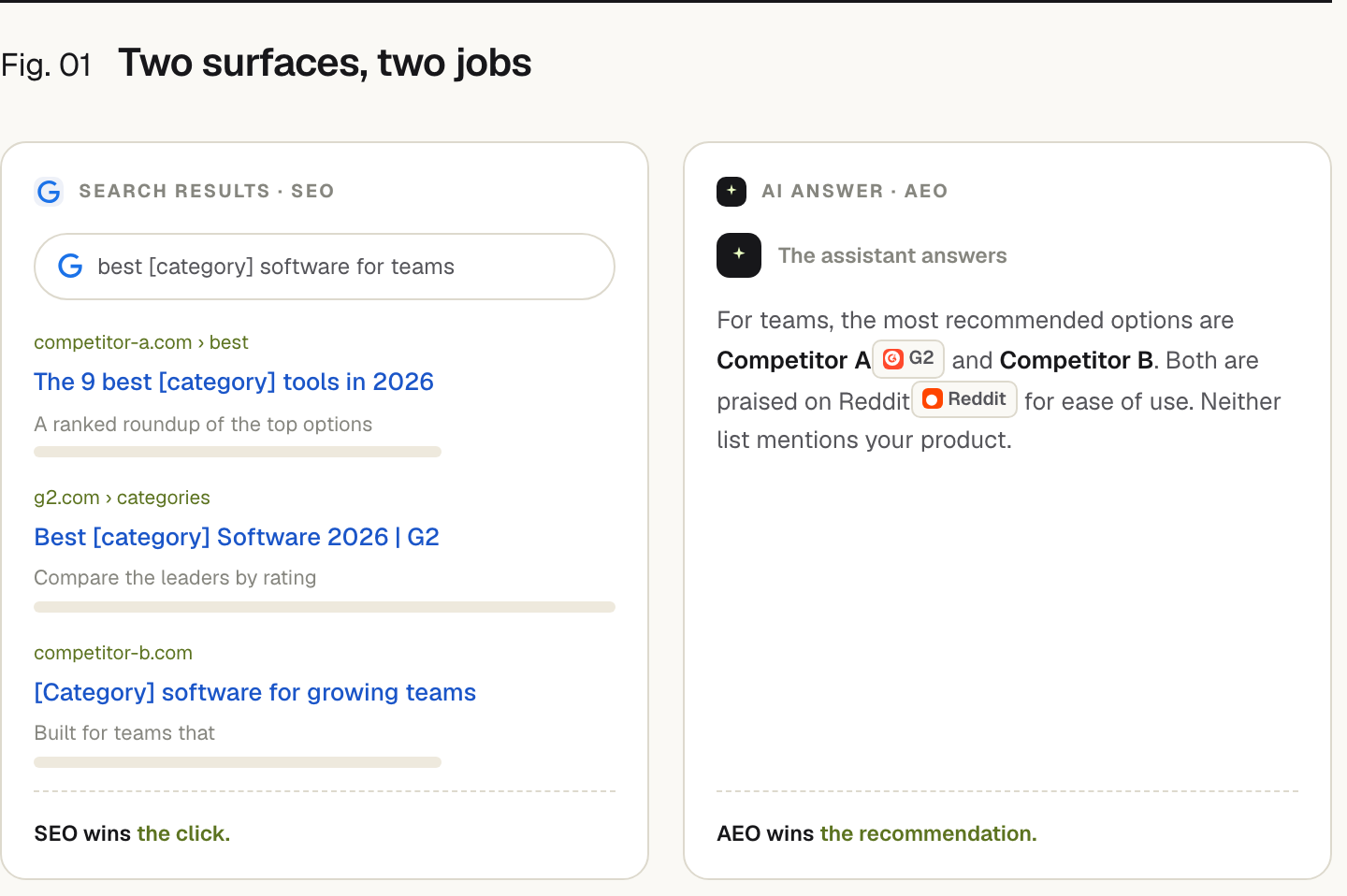
That difference in surface drives everything else. A ranking is a position you can climb; a citation is a judgment you either earn or don’t. A link invites a click; an answer replaces the search. This is why “is AEO just SEO?” is the wrong question. It’s the same intent (be discoverable) through a different mechanism.
What each one rewards#
Because the surfaces differ, the signals differ. Optimize for the wrong ones and you can rank beautifully while staying invisible in AI answers, or the reverse.
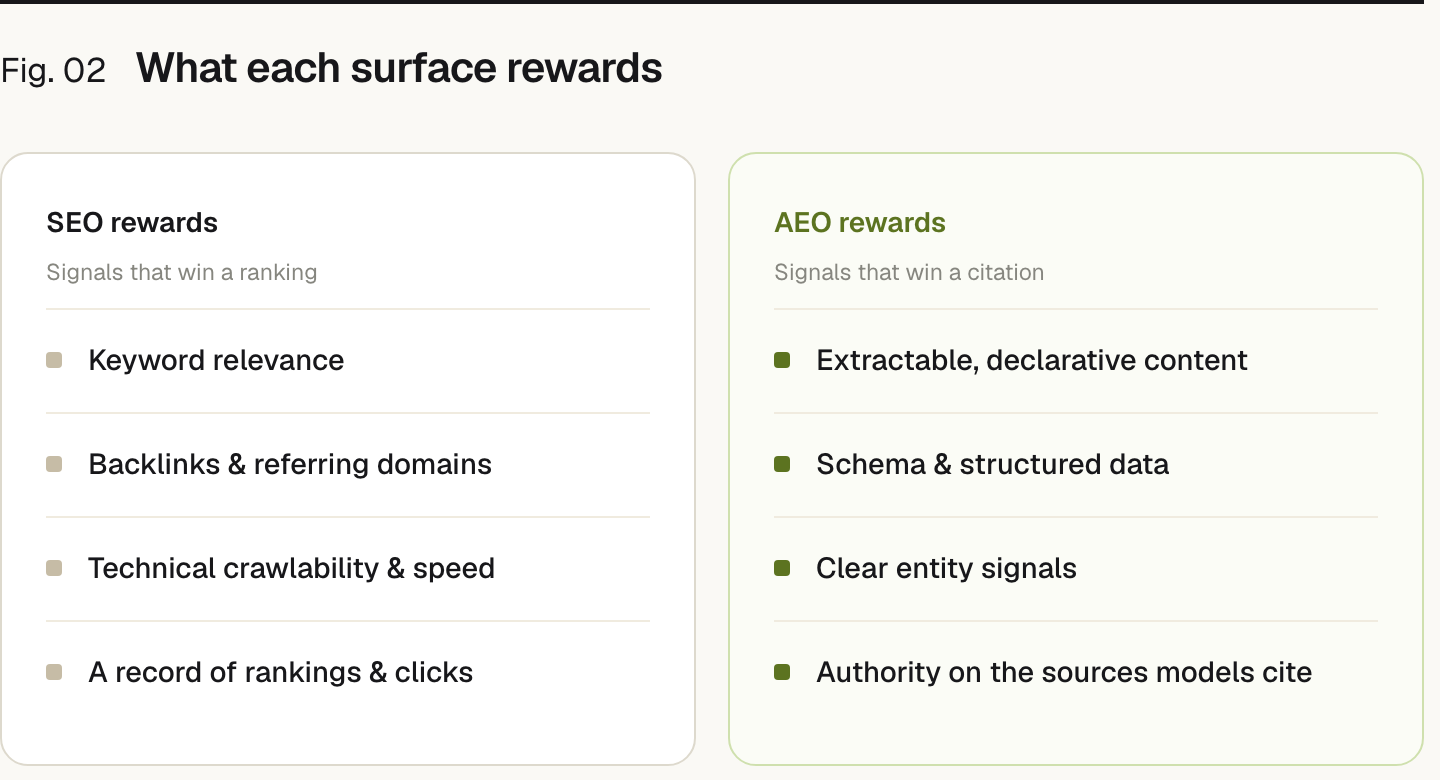
SEO rewards keyword relevance, backlinks and referring domains, technical crawlability and speed, and a track record of rankings and clicks. The unit of success is a position for a query.
AEO rewards content a model can extract and quote (declarative, answer-first, specific), structured data that labels what is an answer to what (FAQPage, Article, schema), clear entity signals so the model knows who you are, freshness, and authority on the third-party sources models actually cite: review grids like G2, community threads like Reddit, and comparison pages. The unit of success is a citation in an answer.
Where they overlap: the shared foundation#
AEO and SEO are not disjoint. They sit on a common base, which is why doing one well usually helps the other.
Crawlable, fast, well-structured pages help search engines index you and help models read you. Real authority, earned links and mentions from credible sites, is a ranking signal and a signal that a model can trust and cite you. Topical depth, a genuine cluster of content on a subject, lifts rankings and makes a model treat you as a source worth quoting. Get the foundation right and you are competitive on both surfaces before you do anything surface-specific.
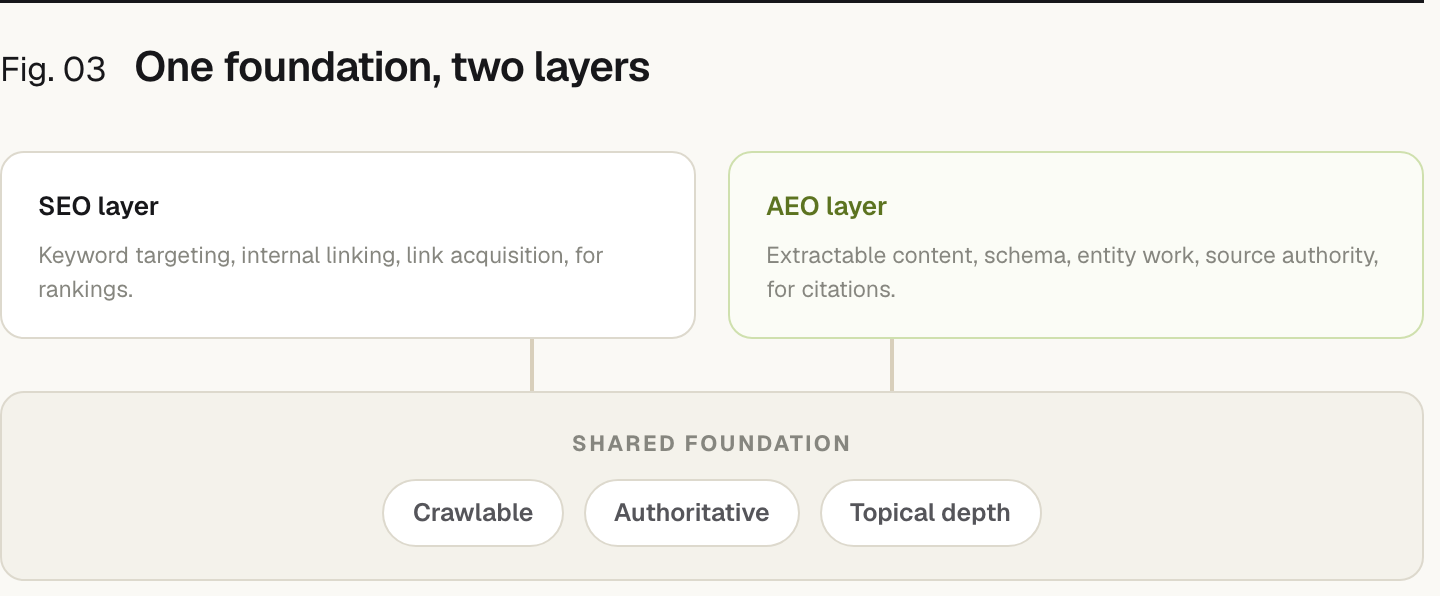
Where they diverge is the layer on top. SEO’s layer is keyword targeting, internal linking for rank flow, and link acquisition. AEO’s layer is answer-first writing, schema, entity work, and earning presence on the specific sources models cite. Skip the AEO layer and a strong SEO site still gets passed over in answers. Skip the SEO foundation and the AEO layer has nothing solid to stand on.
When each one matters#
Neither surface has replaced the other, so the honest framing is about where your buyers are.
SEO still wins the click. Nearly everyone still searches Google, and for high-intent queries a top organic result drives real traffic that converts. If you turned SEO off, you would feel it.
AEO wins the answer. A fast-growing share of buyers, especially in B2B software, open ChatGPT or Perplexity to research before they ever run a Google search. On that surface, the assistant hands them a shortlist. If you are not cited in it, you are invisible at the moment of decision, and the names already cited get harder to displace every month.
The two often happen in one session: a buyer asks an assistant for a shortlist, then Googles the names it gave them. AEO shapes which names they get; SEO wins the click once they search. That is the practical case for running both.
How to run both without doing double the work#
You do not need two separate programs. You need one program with a shared foundation and two thin layers on top.
- Fix the foundation once. Crawlable, fast, well-structured pages; real authority; genuine topical depth. This serves both surfaces.
- Keep your SEO layer. Target the queries that convert, structure internal links, earn quality backlinks, and track rankings and clicks in Search Console.
- Add the AEO layer. Rewrite key pages answer-first so a model can lift a clean claim; add FAQPage and Article schema; sharpen your entity signals; and earn presence on the third-party sources models cite (reviews, communities, comparison pages).
- Measure both. Rankings and clicks for SEO; citation rate and share of voice across engines for AEO. When you can see both numbers side by side, you can tell which surface is leaking and where to spend next.
AEO is not the death of SEO, and SEO is not enough on its own anymore. The brands that win the next few years will treat AI answers and search results as two surfaces of the same job, and run one program that shows up on both.
To see where you stand on the AEO side, run a free AI visibility audit and get your citation rate and share of voice across every major engine. For the deeper definition, read what answer engine optimization is, or compare it with its broader sibling in AEO vs GEO.
Frequently asked questions
Is AEO replacing SEO?
No. AEO (answer engine optimization) is a layer you add on top of SEO, not a replacement. SEO still wins the click when someone searches Google and picks a link. AEO wins the citation when someone asks an AI assistant a question and takes the answer. Both surfaces coexist, and the same buyer often uses both in one research session, so the practical answer is to keep your SEO foundation and add the AEO layer, not choose between them.
What is the difference between AEO and SEO?
SEO (search engine optimization) competes for a ranking position in a list of links; the user still clicks through and decides. AEO (answer engine optimization) competes for a citation inside a single AI-generated answer, where the assistant has already synthesized a recommendation. SEO optimizes for keywords, backlinks and crawlability; AEO optimizes for extractable, declarative content, schema markup, entity clarity, and authority on the third-party sources models trust, like G2, Reddit and comparison pages.
Do I need both AEO and SEO?
For most brands, yes. If your buyers still search Google (nearly all do), SEO drives the clicks that convert. If your buyers also ask ChatGPT, Perplexity, Gemini or Google AI Overviews (a fast-growing share do), AEO decides whether you are cited before they ever reach your site. Because the two share foundations, doing AEO well usually strengthens your SEO, and neglecting SEO undercuts your AEO.
Does good SEO help AEO?
Partly. A crawlable, authoritative, well-structured site is a head start on both, because models read much of the same open web that search engines do. But AEO adds requirements SEO does not reward directly: answer-first declarative writing that is easy to lift, FAQPage and Article schema, clear entity signals, freshness, and presence on the specific third-party sources (review sites, communities, comparison pages) that models cite. Strong SEO without those additions leaves citations on the table.
How do you measure AEO vs SEO?
SEO is measured by keyword rankings, impressions and organic clicks (in tools like Google Search Console). AEO is measured by citation rate (how often a model names you), share of voice (how you compare to competitors cited in the same answers), and the sources behind each answer, tracked across engines like ChatGPT, Perplexity, Claude, Gemini and Google AI Overviews. A platform like Visibly tracks the AI-citation side and unifies it with your Search Console and Analytics data.