AI Visibility Checker
See whether ChatGPT, Claude, and Perplexity name and cite your brand when buyers ask which tool to choose. Drop your URL and get your share of AI answers, the competitors named instead of you, and what to fix, in about 15 minutes.
An AI visibility checker is a free tool that shows whether AI assistants like ChatGPT, Claude, and Perplexity mention or cite your brand when buyers ask about your category, how large your share of AI answers is, and which competitors get named instead of you. It is the fastest way to answer one question: when your buyers ask AI, are you in the answer?
A full AI visibility audit, not a score.
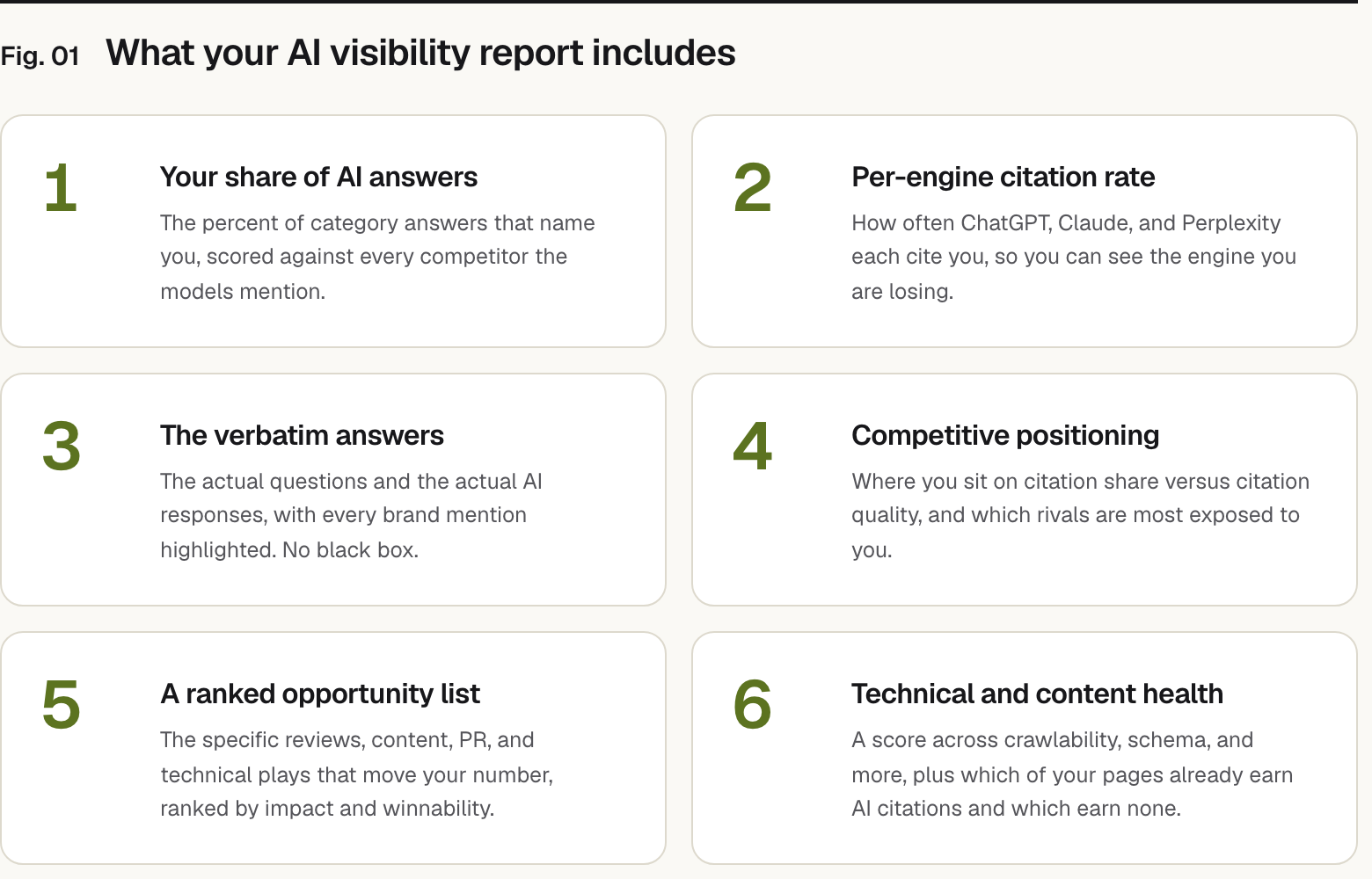
Most free checkers hand you one number and a signup wall. This one reads your homepage, auto-discovers up to 13 competitors, tests 6 high-intent prompts across 3 engines, and returns a report that reads like a consultant audit. Here is what is inside.
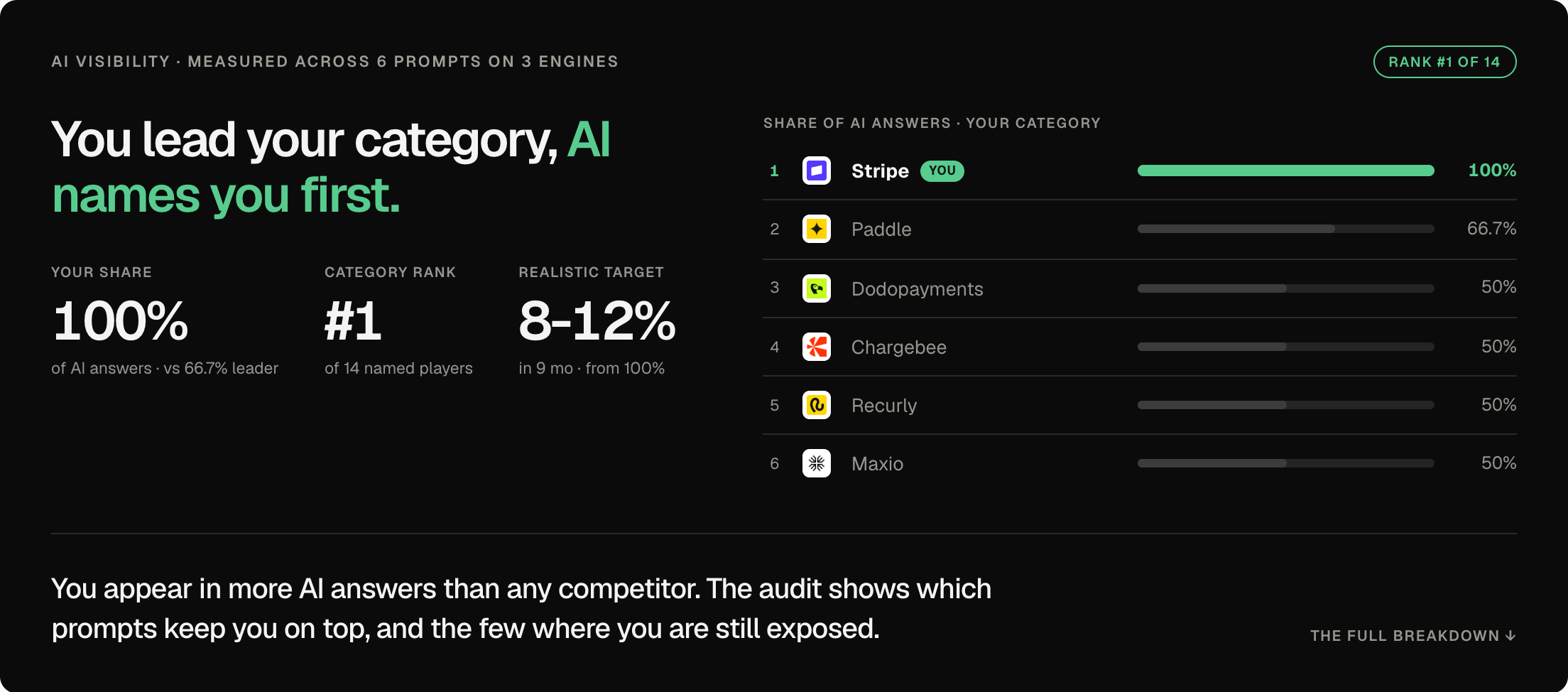
Your share of AI answers, ranked against rivals.
The headline metric is share of AI answers: the percent of category questions where the assistant names you, scored against the competitors it names too. In a real check of stripe.com, Stripe appeared in 100% of its category answers, ahead of Paddle at 66.7% and a cluster of billing tools at 50%. Your report shows the same ranking for your category, so you know exactly who you are up against.
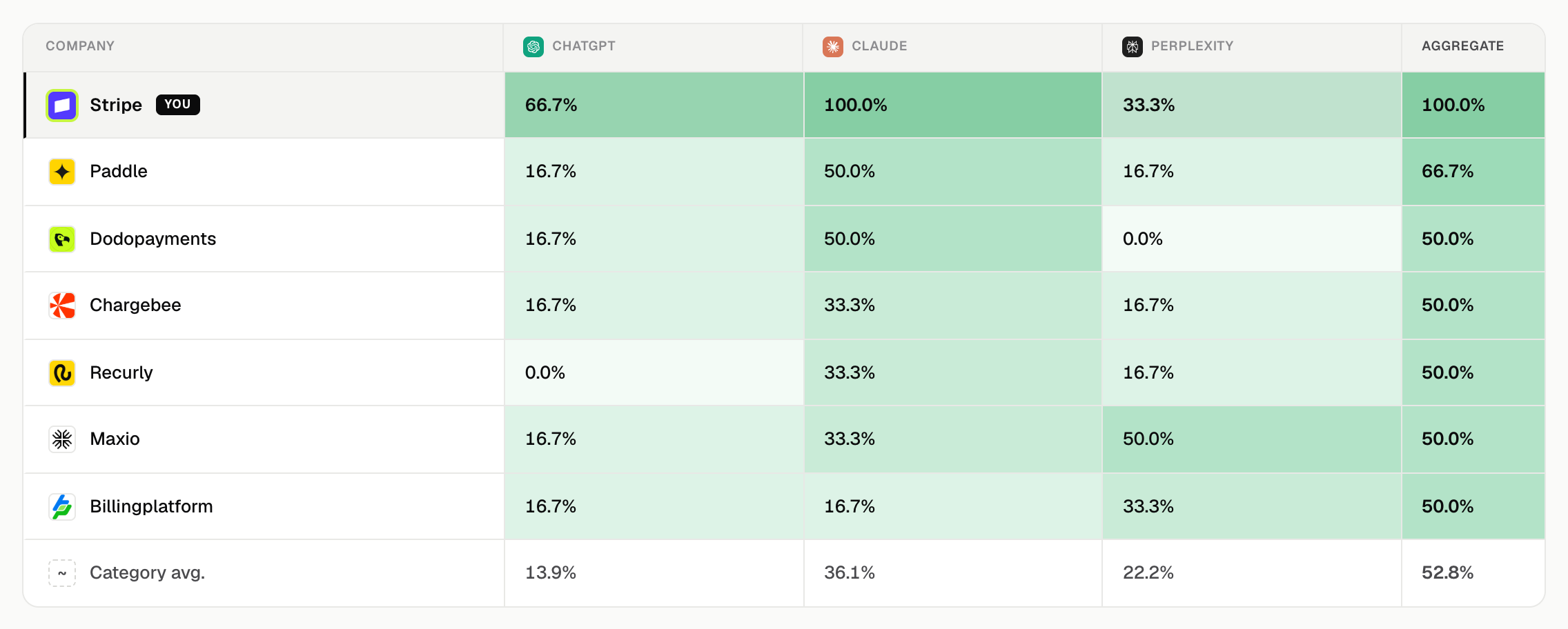
See where you win, and on which engine you lose.
ChatGPT, Claude, and Perplexity do not agree. You can be the top answer on one and invisible on another. The checker breaks your citation rate down by engine so you fix the right gap. In the report below, Stripe is cited in 100% of Claude answers but only 33.3% on Perplexity, the engine where it has the most to gain.
Buyers now ask AI which tool to choose, and they take the answer as the answer. If your brand is missing, you are invisible at the moment of decision. The check tells you whether you are in the answer, before it costs you the deal.
One URL in, a full report out.
No prompts to write, no competitors to list, no signup to start. You give it your homepage and it does the rest.
Drop your homepage URL and pick the market you sell in. One field, no signup.
We infer your category, ideal customer, and competitors from your homepage. You confirm before anything runs.
We ask high-intent buying questions across ChatGPT, Claude, and Perplexity, the way your buyers actually ask them.
In about 15 minutes you get your share of AI answers, the competitive gap, and a ranked list of what to fix first.
From absent to cited.
Ask an assistant which tool to choose and it does not return links. It returns one answer: a short list of named brands and the sources it trusts. Your check shows which of those answers you are in, and which you are missing. Closing the gap is the work that takes you from absent to named and cited.
![The same question, 'what is the best [category] tool?', answered twice. Before the AEO work: the assistant recommends Competitor A (cited from G2) and Competitor B (praised on Reddit), and your brand is not mentioned. After the work: the assistant names Competitor A, Competitor B and your brand, now cited from a comparison guide.](/figures/checker-absent-to-cited.png)
A ranked list of what to fix first.
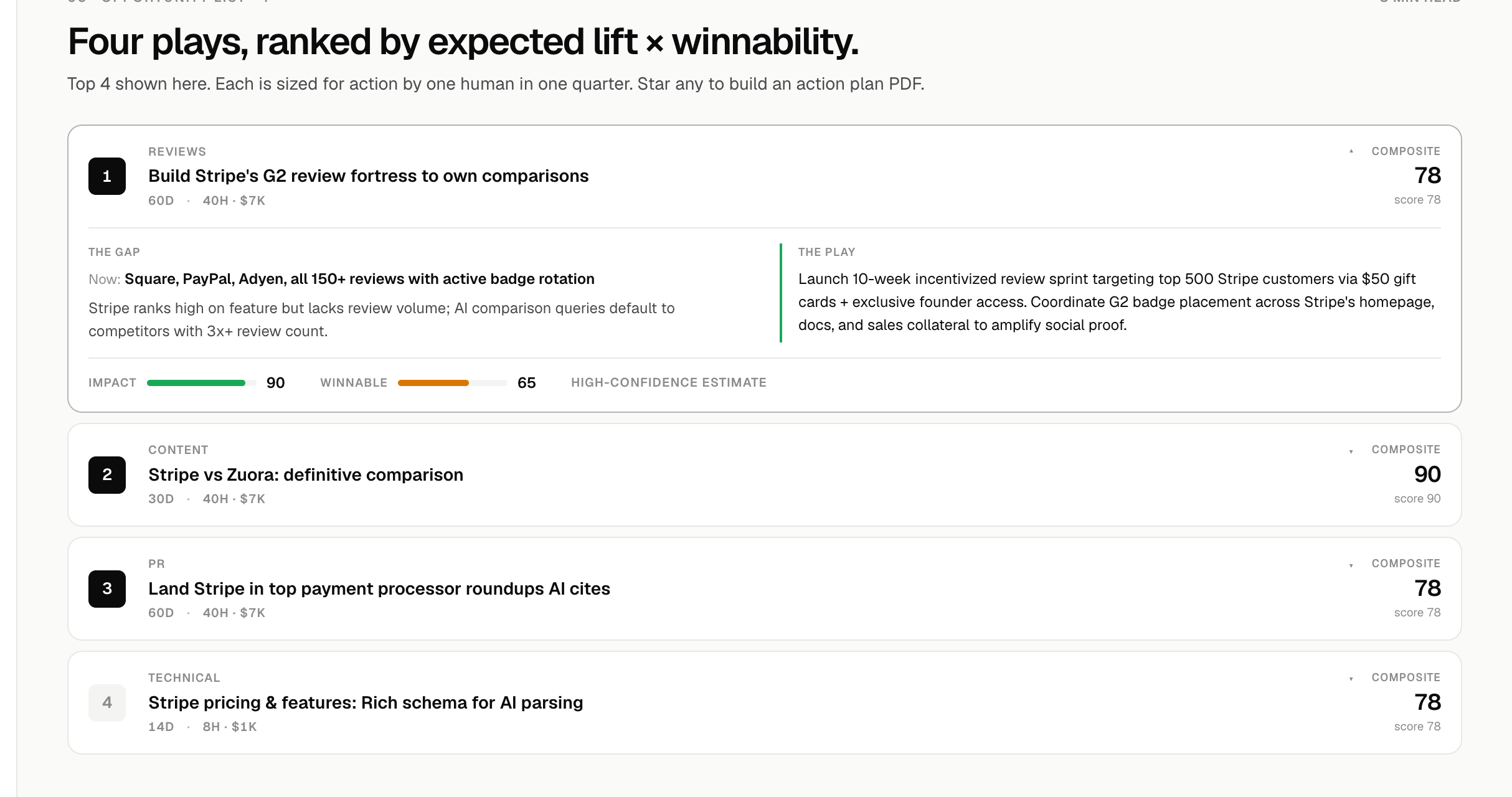
A score you cannot act on is a vanity metric. Every report ends with an opportunity list: the specific reviews, content, PR, and technical plays that move your number, each scored by impact and winnability so you start with the one that pays back fastest. From there, these guides show how to work it: structure your content so models can lift it (answer engine optimization), build authority on the sources they cite (generative engine optimization), and track your share of voice as it moves.
Open a real AI visibility report.
These are complete, live sample reports, the same thing you get for your own brand. Open one and read every section: the share of AI answers, the verbatim prompts, the competitive landscape, and the opportunity list.



These are public sample reports Visibly generated for well-known brands, using the same method as your own check. Your report is private and visible only to you.
What to look for in an AI visibility checker.
Most free AI visibility checkers are lead-capture boxes that return one number. Six things separate a checker worth your 15 minutes from a score built to grab your email.
ChatGPT, Claude, and Perplexity answer differently. A checker that reads a single engine gives you a fraction of the picture.
You should see the actual AI response and the sources behind it, not just a score you are asked to trust.
Share of AI answers only means something next to the specific rivals the models name instead of you.
The prompts should be the high-intent questions your buyers ask, not a generic search for your brand name.
A number with no next step is a vanity metric. A good checker ranks the plays that actually move it.
Answers shift by engine, session, and market. A checker that hides that is selling certainty it does not have.
AI visibility checker vs a score box vs an SEO tool.
Three kinds of free tools claim to check your AI visibility. Only one reads multiple engines, shows the answer behind the score, and tells you what to do. Here is how the types line up on the axes that decide whether the result is useful.
| Capability | Visibly checkerOur product | Typical free checker | SEO tool free checker |
|---|---|---|---|
| AI engines read | ChatGPT, Claude, Perplexity | Usually one engine | None; keyword ranks |
| Shows the verbatim AI answer | |||
| Scores you vs auto-found competitors | |||
| Ends with a ranked action plan | |||
| See your results without a signup |
Comparison of checker types, not specific vendors; capabilities vary by tool. Visibly is our product. Checked July 2026.
Most checkers give you a number. This gives you the receipts.
It checks ChatGPT, Claude, and Perplexity together, the assistants that actually cite sources, not a single-engine snapshot on a slow refresh.
You see the verbatim answers and the sources behind them, so the number is auditable. Honest measurement is the whole point, not a vanity gauge.
The report ends with a ranked list of reviews, content, PR, and technical plays, so you know what to do on Monday, not just how bad it is.
One field, about 15 minutes, no card. The full platform adds daily monitoring and the work to close the gap.
AI visibility checker, answered.
What is an AI visibility checker?
An AI visibility checker is a free tool that shows whether AI assistants like ChatGPT, Claude, and Perplexity mention or cite your brand when buyers ask about your category. A good one measures your share of AI answers, ranks you against the competitors the models name, shows the verbatim answers behind the score, and tells you what to fix to get cited more often.
How do I check if ChatGPT mentions my brand?
Run the free checker, drop in your homepage URL, and it asks ChatGPT, Claude, and Perplexity the high-intent buying questions your customers use. For each one it records whether you were cited, mentioned weakly, or left out entirely, and shows you the actual AI response with your brand and your competitors highlighted, so you see exactly where you win and where a rival is named instead.
Does ChatGPT recommend my brand to buyers?
The only way to know is to test the questions your buyers actually ask. The checker runs your category's buying prompts through ChatGPT and reports how often you are named, where you rank in the answer, and which competitors ChatGPT recommends instead. In a real audit of stripe.com, for example, Stripe was cited in 66.7% of ChatGPT answers for its category, ahead of a field of billing tools.
Is the AI visibility checker free?
Yes. The checker is free, needs no signup, and runs from a single URL field in about 15 minutes. You get the full audit report at no cost. Ongoing daily monitoring across engines and the work to close the gaps are the paid plans: Visibly starts at $49 a month (Starter) and $249 a month (Growth), with a free trial on every paid plan.
Which AI engines does the checker cover?
The free check runs across ChatGPT, Claude, and Perplexity, the three assistants that cite sources and shape most buying answers today. The full Visibly platform tracks citations across more engines, including Gemini and Google AI Overviews, on a daily refresh.
What does the AI visibility report include?
The report includes your share of AI answers, your category rank against auto-discovered competitors, a per-engine citation-rate breakdown, the verbatim prompts and answers, a competitive positioning quadrant, a ranked opportunity list of plays to run, a technical health score across crawlability and schema, and a content audit of which pages earn AI citations. It reads like a consultant audit, not a single number.
What is a good share of AI answers?
It depends entirely on your category and how many players the models name. Share of AI answers is your citation rate scored against your competitors, so the number that matters is your rank, not an absolute percentage. The report gives you a realistic target for your category: a dominant brand might defend a high share, while a challenger's first goal is simply to appear in answers it is absent from today.
How is this different from an SEO or keyword tool?
An SEO tool measures your rank in a list of blue links. An AI visibility checker measures whether you are named and cited inside a single synthesized answer, which depends on clear extractable content, source authority, and presence across the places AI models read. The two reinforce each other, but a keyword rank tells you nothing about whether ChatGPT recommends you.
AI answers change every time, so how accurate is the check?
Answers do vary by engine, session, and market, and a tool that hides that is selling a vanity number. The checker runs multiple high-intent prompts across three engines, reports a confidence score with the result, and shows you the verbatim answers so you can verify every citation yourself. You measure the trend, not a single lucky or unlucky response.