Free AI visibility tools
Practical, no-signup tools to see how AI search treats your brand and fix what is holding you back. Measure your citations across ChatGPT, Claude, and Perplexity, then close the gaps. Start with the checker.
AI visibility tools measure and improve whether AI assistants like ChatGPT, Claude, and Perplexity name and cite your brand when buyers ask about your category. They do two jobs: measurement (see where you stand, and against whom) and optimization (fix the technical and content gaps that keep you out of the answer). Every tool on this page is free.
The free tools, and what each is for.
One is live today. The rest ship over the next few weeks. Each does one job well, and they are designed to be used together.
See whether ChatGPT, Claude, and Perplexity cite your brand, your share of AI answers, and how you rank against competitors. One URL, no signup.
Generate an llms.txt file so AI crawlers can find and prioritize your best pages.
Check whether GPTBot, ClaudeBot, PerplexityBot, and Google-Extended can reach your site.
Build the JSON-LD structured data that helps AI engines parse and cite your pages.
Turn your citation counts into a share-of-voice score against your competitors.
Every AI visibility tool does one of two jobs.
Measurement tells you where you stand. Optimization changes it. The best free stack covers both, because a score you cannot act on is a vanity metric, and work you cannot measure is a guess.
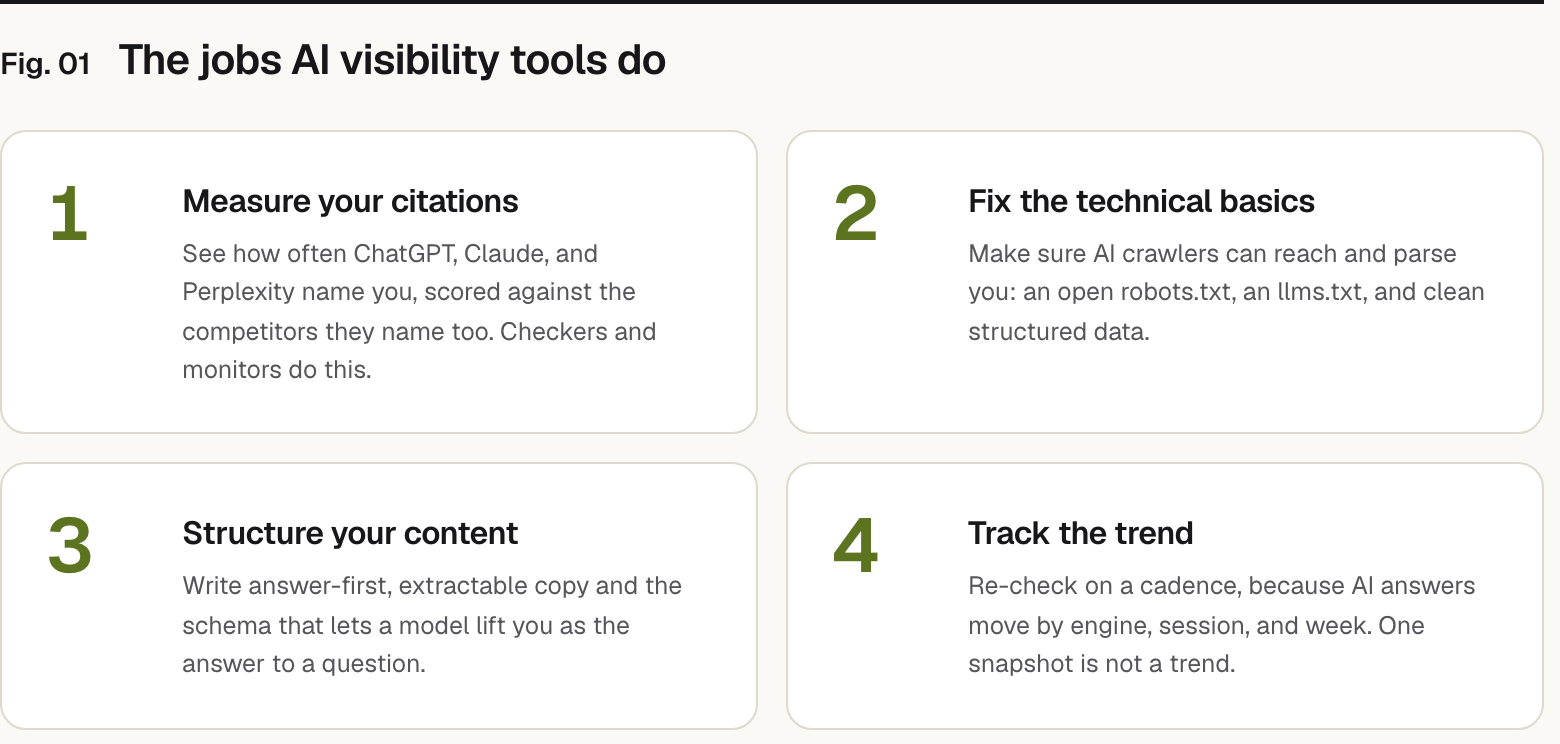
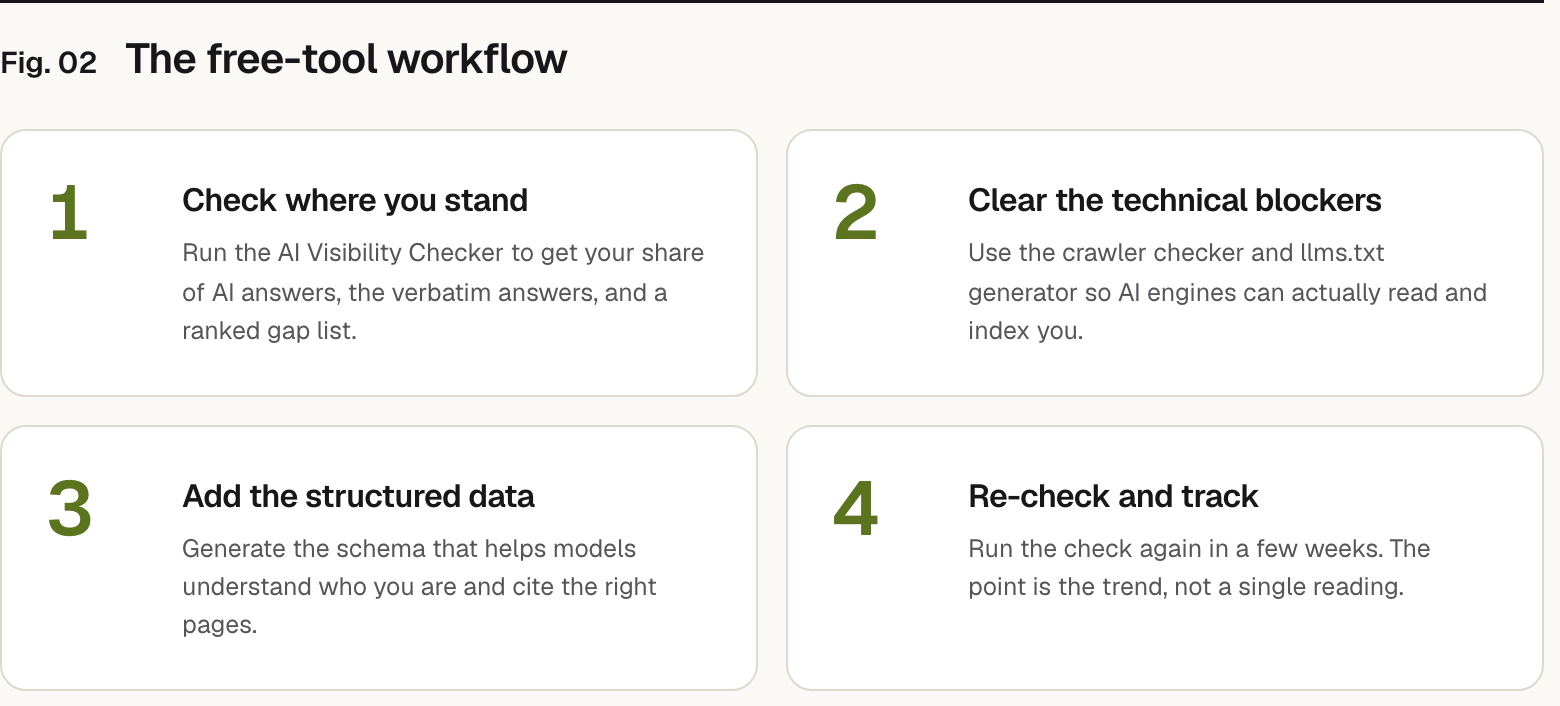
You cannot fix what you have not measured, and you cannot measure your way to the answer. The free tools are a loop: check, fix, re-check.
How to use the free tools together.
Run them in order. Start by measuring, clear the technical blockers, add the structure that helps models cite you, then re-check to see the number move.
From absent to cited.
The reason any of this matters: when a buyer asks an assistant which tool to choose, it returns one answer, a short list of named brands. These tools take you from missing in that answer to named and cited.
![The same question, 'what is the best [category] tool?', answered twice. Before the AEO work: the assistant recommends Competitor A (cited from G2) and Competitor B (praised on Reddit), and your brand is not mentioned. After the work: the assistant names Competitor A, Competitor B and your brand, now cited from a comparison guide.](/figures/tools-absent-to-cited.png)
What to look for in a free AI visibility tool.
Plenty of free AI visibility checkers are lead-capture boxes that hand you one number and a signup wall. Four things separate a tool worth your time.
Not a keyword database in a new coat. A real AI visibility tool queries ChatGPT, Claude, or Perplexity directly.
You should see the verbatim answer and the sources behind it, not a single opaque score you have to trust.
No signup wall before you see the result. A free tool that gates the answer is a lead form.
Measurement with no next step is a vanity metric. A good tool ends with the plays that move the number.
Free AI visibility tools, answered.
What is an AI visibility tool?
An AI visibility tool measures and improves whether AI assistants like ChatGPT, Claude, and Perplexity mention or cite your brand when buyers ask about your category. Measurement tools (checkers and monitors) show your share of AI answers against competitors; optimization tools (llms.txt generators, schema generators, crawler checkers) fix the technical and content gaps that keep you out of the answer.
Are these AI visibility tools free?
Yes. Every tool on this page is free to use. The AI Visibility Checker needs no signup and runs from a single URL in about 15 minutes. The full Visibly platform adds daily monitoring across more engines and the work to close the gaps, starting at $49 a month (Starter) and $249 a month (Growth), with a free trial on every paid plan.
What is the best free AI visibility tool?
Start with an AI visibility checker, because you cannot fix what you have not measured. The best one reads multiple engines (ChatGPT, Claude, and Perplexity), scores you against named competitors, shows the verbatim answers, and ends with a ranked list of what to fix. Once you have your gaps, the technical tools (llms.txt generator, schema generator, crawler checker) help you close them.
How are AI visibility tools different from SEO tools?
SEO tools measure your rank in a list of blue links. AI visibility tools measure whether you are named and cited inside a single synthesized answer, which depends on extractable content, source authority, and presence across the places AI models read. The disciplines reinforce each other, but a keyword rank tells you nothing about whether ChatGPT recommends you.
Do AI visibility tools work for ChatGPT, Claude, and Perplexity?
Yes. The AI Visibility Checker runs high-intent buying questions across ChatGPT, Claude, and Perplexity and reports how often each cites you. The full platform tracks more engines, including Gemini and Google AI Overviews, on a daily refresh.
What do GEO and AEO tools do?
GEO (generative engine optimization) and AEO (answer engine optimization) tools help you win citations inside AI answers. They cover the same two jobs as any AI visibility tool: measuring how often models cite you, and optimizing your content, structure, and authority so they cite you more. GEO is the broader term; the tactics overlap almost completely.