How to appear in Google AI Overviews in 2026
A specific guide to getting cited in Google AI Overviews: how the query fan-out works, the four signals that earn a citation, and a step-by-step checklist you can run this week.

Google AI Overviews are built by a query fan-out: Google splits your question into sub-queries, pulls passages from many pages, and synthesizes one answer with links. You get cited by ranking for those sub-queries with passage-level answers, schema, corroboration, and freshness. Blocking Google-Extended does not hide you from AI Overviews; it only affects Gemini training.
- AI Overviews use a query fan-out: one question becomes several sub-queries, each retrieving passages that get synthesized into a single answer with citations.
- Cited pages usually rank in the top organic results for the underlying sub-queries, so classic ranking still matters, but passage-level extractability is what wins the citation.
- Corroboration counts: AI Overviews favor claims that appear consistently across multiple credible sources, which is why off-page presence matters as much as your own page.
- Google-Extended controls Gemini and Vertex training, not AI Overviews. You cannot opt out of AI Overviews without blocking Googlebot and losing Search entirely.
- Measure across engines. AI Overviews, ChatGPT, Perplexity, Claude, and Gemini cite different sources for the same question, so single-surface tracking is misleading.
Google AI Overviews are built by a query fan-out: Google breaks your question into several sub-queries, retrieves passages from many pages, and synthesizes one answer with links. You do not “submit” to an AI Overview. You earn a citation by ranking for the sub-queries, answering them at the passage level, and getting your claim corroborated across sources. This guide explains how the fan-out works, the four signals that win citations, and a step-by-step checklist you can run this week.
How Google assembles an AI Overview#
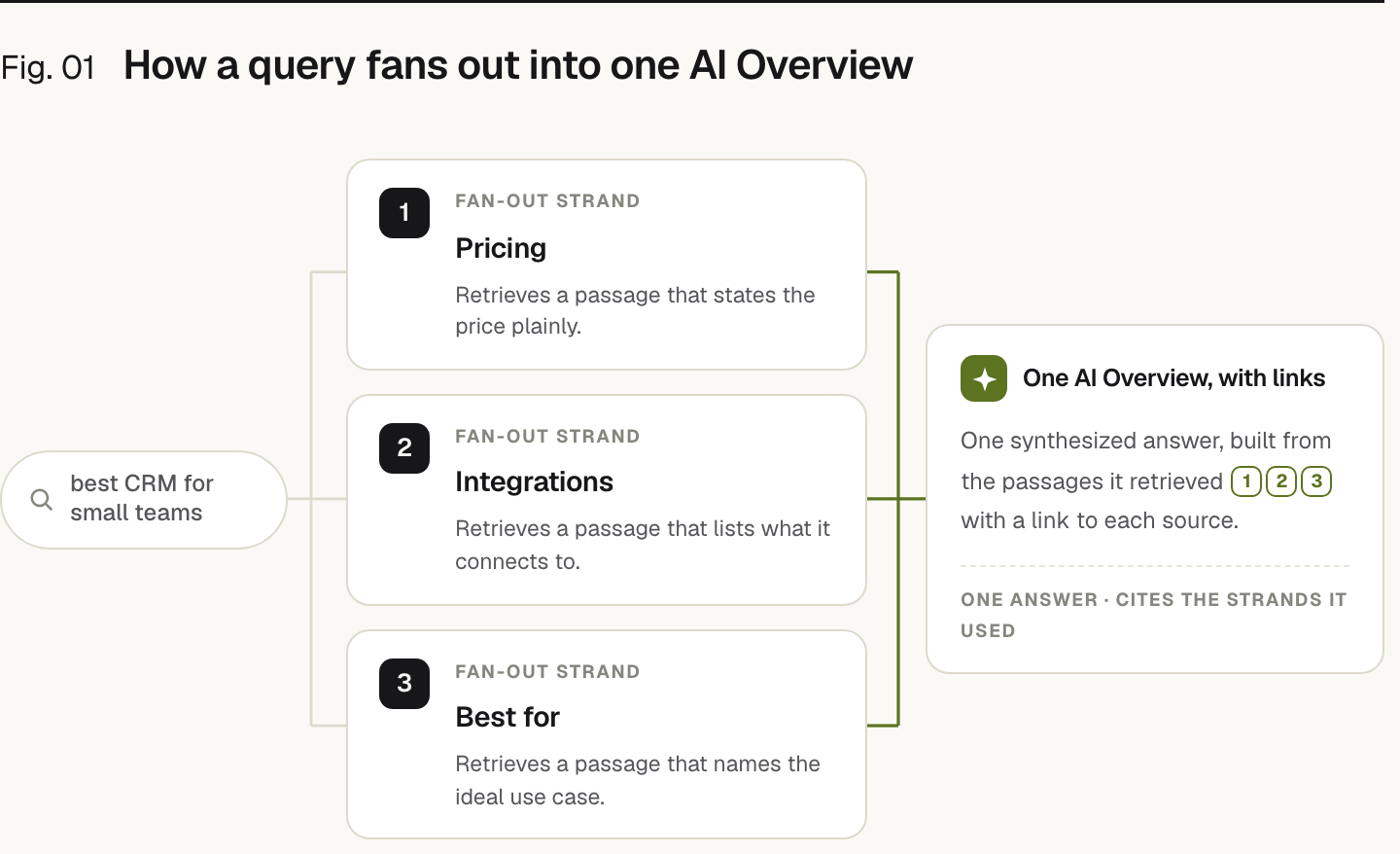
An AI Overview is not a single search result rewritten. When a query is eligible, Google runs a query fan-out: it decomposes the question into related sub-queries, searches its index for each, selects passages from the results, and asks Gemini to synthesize one grounded answer with citations back to the sources.
That means a page can be cited even if it does not rank first for the head term, as long as it owns one of the sub-queries with a clean, extractable passage. It also means you are not competing for one slot; you are competing for a passage in each strand of the fan-out.
The four signals that win an AI Overview citation#
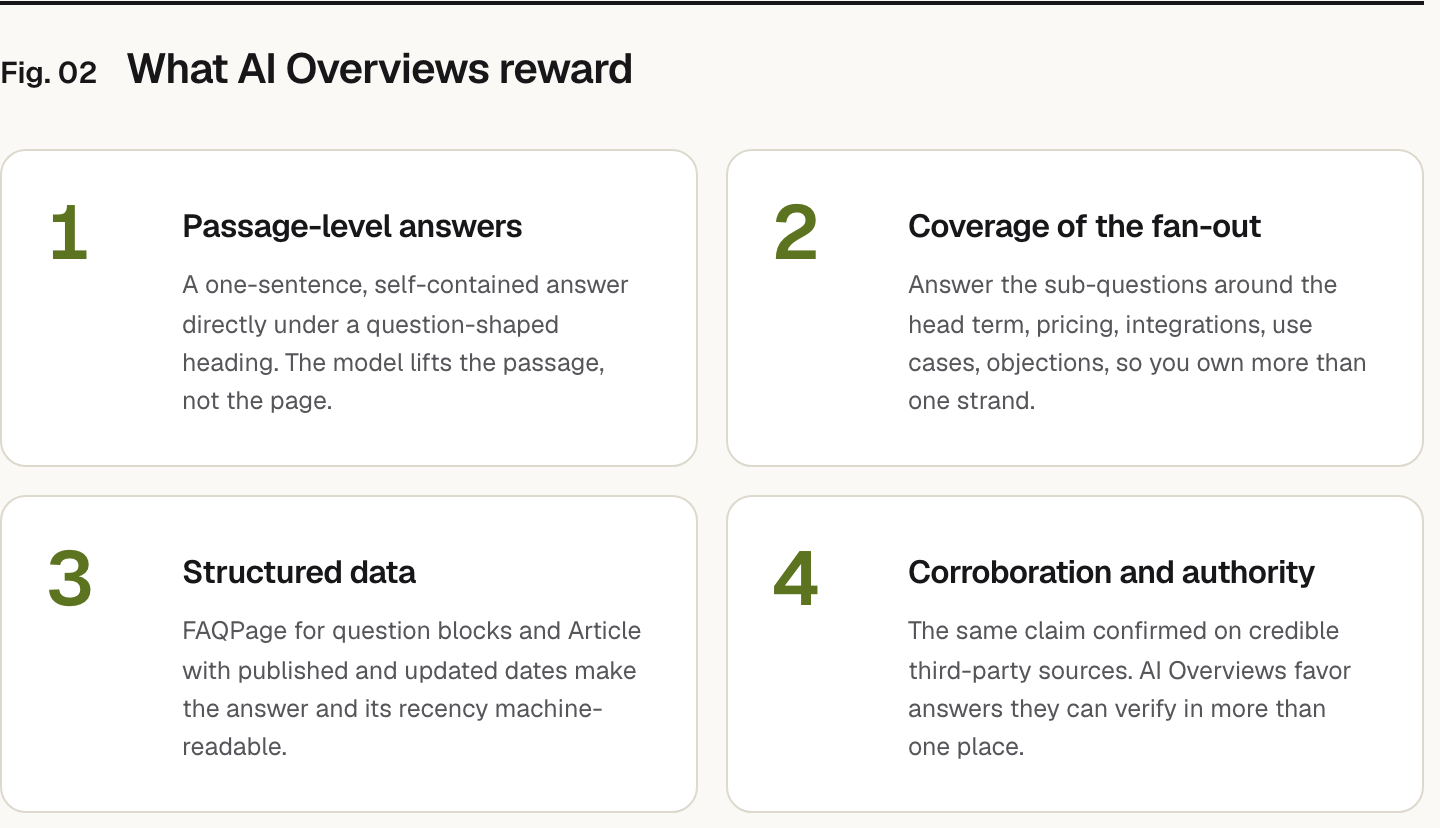
Pages that get cited share four traits. All four are structural, and all four are within your control.
Write answer-first, for the passage#
Open every section with a one-sentence answer, then justify it. If the heading is “How much does X cost?”, the first sentence should state the price. AI Overviews extract the passage that answers the sub-query most cleanly, so bury the answer and you hand the citation to a competitor who did not.
Corroboration is an off-page job#
The signal teams most often miss is corroboration. AI Overviews favor claims that appear consistently across multiple credible sources, so a fact that lives only on your own site is weaker than the same fact confirmed on a review grid, a comparison page, and a community thread. This is why winning AI Overviews is partly on-page and partly the off-page work of getting cited elsewhere, the same work that moves your standing in ChatGPT and Perplexity.
![The same question, 'what is the best [category] tool?', answered twice. Before the AEO work: the assistant recommends Competitor A (cited from G2) and Competitor B (praised on Reddit), and your brand is not mentioned. After the work: the assistant names Competitor A, Competitor B and your brand, now cited from a comparison guide.](/figures/aio-absent-to-cited.png)
The AI Overview checklist#
You can run this in an afternoon. It is the same discipline as good SEO, aimed one layer deeper at the passage.
- Confirm indexation. Googlebot can crawl the page and it is indexed (check Search Console coverage).
- Shape headings as questions. Match the sub-queries people actually ask.
- Answer first. One self-contained sentence under each heading, before the justification.
- Cover the fan-out. Pricing, integrations, best-for, objections, each as its own extractable passage.
- Add schema. FAQPage on question blocks; Article with visible published and updated dates.
- Earn corroboration. Get the claim onto credible third-party sources.
- Measure across engines. Track AI Overviews alongside ChatGPT, Perplexity, Claude, and Gemini.
Where measurement fits#
Because AI Overviews vary by query, location, and session, you cannot eyeball whether you appear. The reliable approach is to monitor a set of target questions on a schedule and record when you are cited, across every engine, since AI Overviews, ChatGPT, and Perplexity pull different sources for the same question. That cross-engine, honest measurement is what Visibly is built for. See the related guides on how to appear in ChatGPT and what GEO is, or run a free AI visibility audit to see where you stand across all five surfaces today.
- How do I get my website in Google AI Overviews?
- What is the query fan-out in AI Overviews?
- Does blocking Google-Extended remove me from AI Overviews?
- Do AI Overviews use the same ranking as regular Google search?
- How is optimizing for AI Overviews different from SEO?
Frequently asked questions
How do I get my website into Google AI Overviews?
There is no submission form. AI Overviews are built from Google's main Search index, so the path is: be crawlable and indexed by Googlebot, rank for the sub-queries Google fans your question into, and structure your page so the answer is extractable at the passage level (a one-sentence answer under a question-shaped heading, plus FAQPage or Article schema). Pages that already rank well and answer cleanly are the ones AI Overviews tend to cite.
What is the query fan-out in AI Overviews?
Query fan-out is Google's technique of breaking a single question into several related sub-queries, running a search for each, and synthesizing the results into one AI Overview. For example, 'best CRM for small teams' might fan out into sub-queries about pricing, integrations, ease of use, and scaling. To be cited, you need passages that answer those sub-queries, not just the head term.
Does blocking Google-Extended remove me from AI Overviews?
No. Google-Extended is a separate control that governs whether your content is used to train and ground Gemini and Vertex AI. AI Overviews are part of Google Search and use the normal Googlebot crawl and index, so the only way to keep a page out of AI Overviews is to block it from Google Search entirely, which also removes it from regular results. For most sites that want visibility, the answer is to allow crawling and optimize for citation.
Do AI Overviews use the same ranking as regular Google search?
Largely, yes, with a twist. Pages cited in AI Overviews usually rank in the top organic results for the underlying sub-queries, so classic SEO still matters. The difference is that AI Overviews reward passage-level extractability and corroboration across sources on top of ranking, so a page that ranks and answers the question in a clean, self-contained passage beats a higher-ranking page that buries the answer.
How is optimizing for AI Overviews different from traditional SEO?
Traditional SEO optimizes a page to rank for a keyword. Optimizing for AI Overviews optimizes a passage to be extracted and cited: you write answer-first, cover the fanned-out sub-questions, add schema, and earn corroboration off-page so the claim is confirmed elsewhere. The reader you are writing for is a model assembling an answer, not only a human scanning results.
How long does it take to appear in AI Overviews?
It depends on how quickly the page is crawled and indexed and how competitive the query is. Once a page is indexed and ranks for the relevant sub-queries, it can be pulled into an AI Overview as soon as Google refreshes the result, which for time-sensitive queries can be days. Corroboration off-page and freshness signals tend to speed inclusion, while thin or unranked pages may never be cited regardless of markup.
Can I track whether my brand appears in AI Overviews?
Yes. Because AI Overviews vary by query, location, and session, the reliable way is to monitor a set of target prompts on a schedule and record when your brand or page is cited, alongside the same prompts on ChatGPT, Perplexity, Claude, and Gemini. That cross-engine view is what a tool like Visibly measures, since each surface cites different sources for the same question.