How to appear in Google Gemini's answers in 2026
A guide to getting cited by Google Gemini: how grounding with Google Search works, what Google-Extended actually controls, and a checklist you can run this week.

Google Gemini answers factual questions by grounding with Google Search: it retrieves from Google's index and cites sources. So the foundation is being indexed, authoritative, and structured, the same as SEO. The one Gemini-specific lever is Google-Extended, which governs whether your content is used by Gemini Apps, including grounding. Unlike AI Overviews, blocking it opts you out of Gemini.
- Gemini is Google's model and it powers two different surfaces: the Gemini app and AI Overviews in Search. Same model, different grounding.
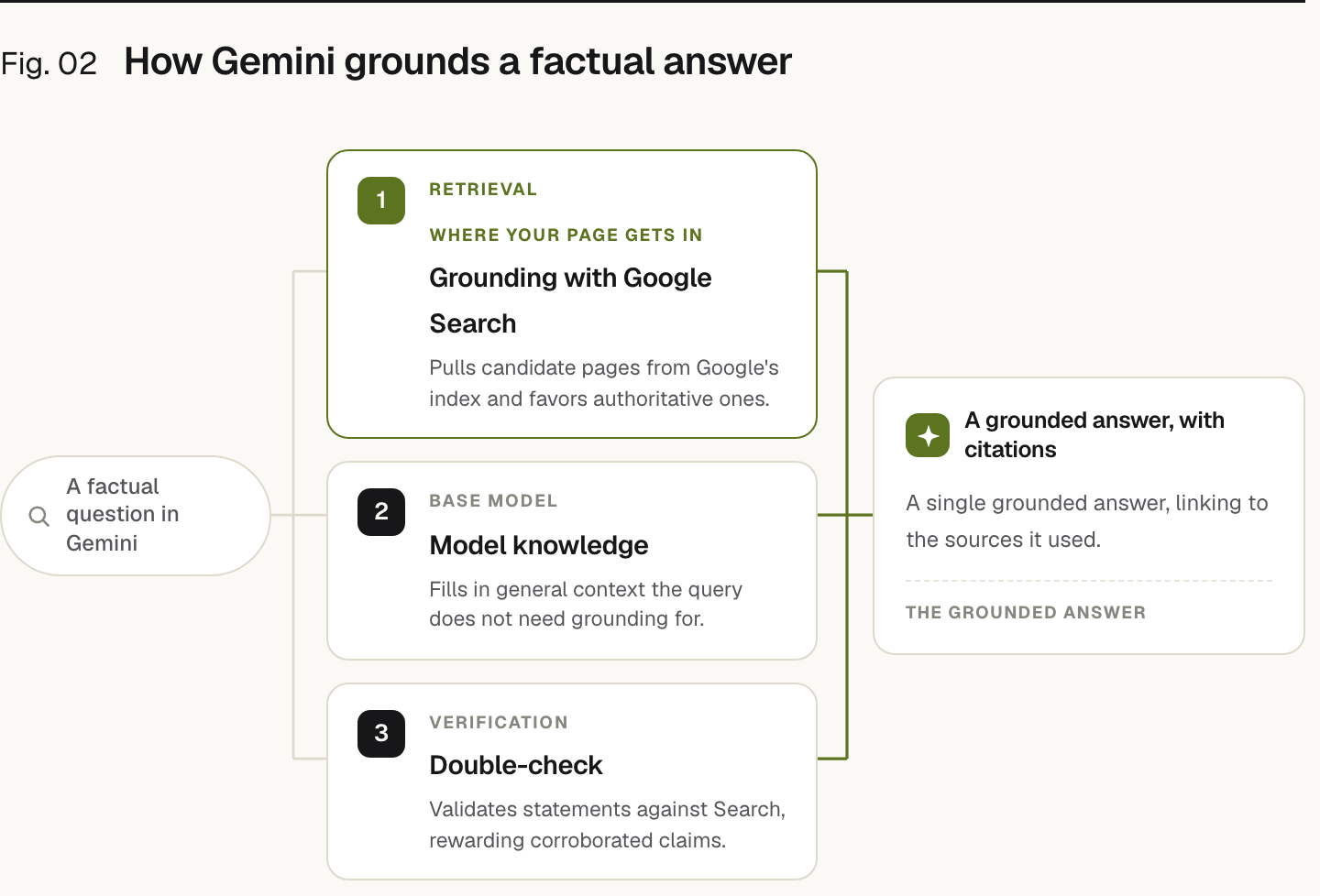
- For factual and current queries, the Gemini app grounds with Google Search, retrieving from Google's index and citing sources, so classic indexing and authority are the foundation.
- Google-Extended controls whether your content is used by Gemini Apps and Vertex AI, including grounding. Blocking it opts you out of Gemini, but not out of Google Search or AI Overviews.
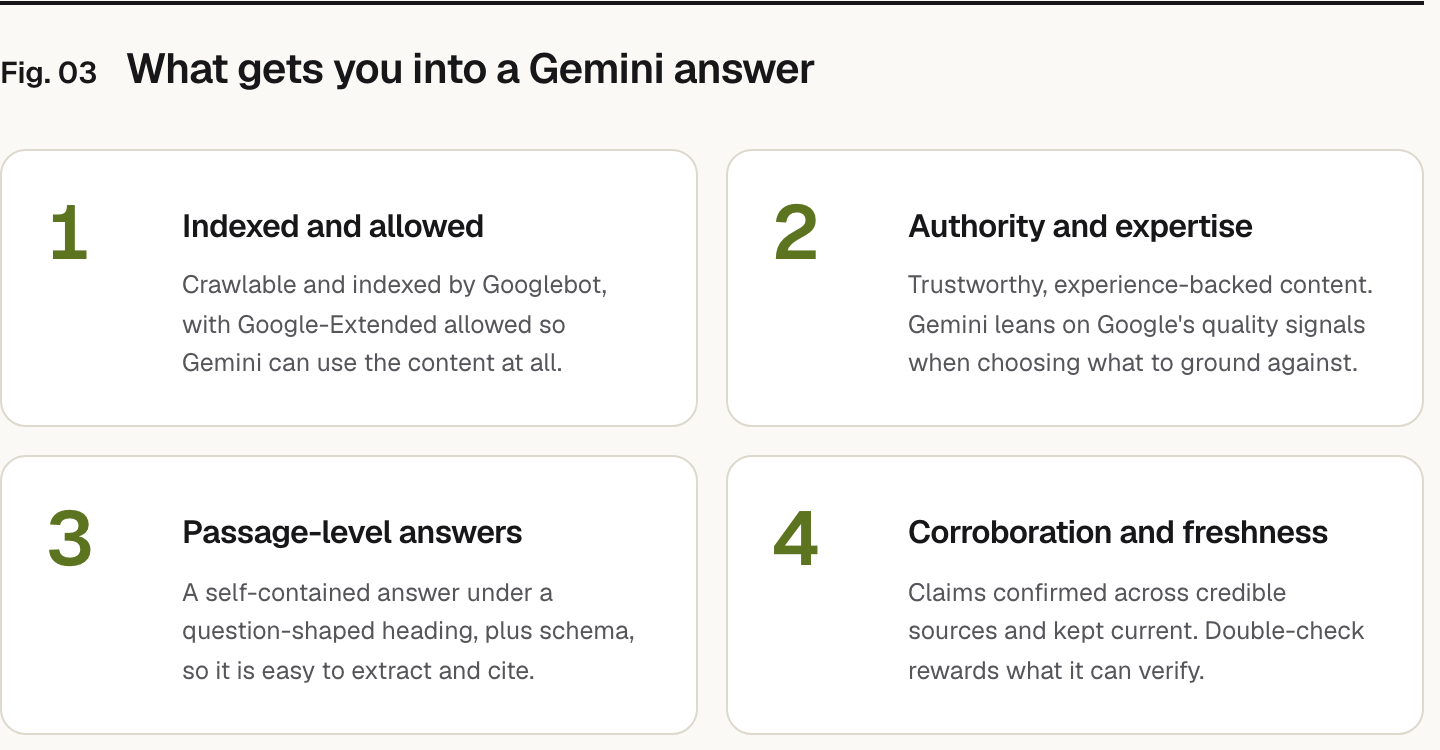
- Gemini leans on Google's quality signals, so authoritative, trustworthy, well-structured pages are favored for grounding, and its double-check feature rewards corroborated claims.
- Gemini is embedded across Search, Workspace, Android, and Chrome, so a citation reaches users in many places at once.
Google Gemini answers factual and current questions by grounding with Google Search: it retrieves from Google’s index and cites the sources it used. So the foundation for appearing in Gemini is the same as SEO, being indexed, authoritative, and structured, with one Gemini-specific lever on top: Google-Extended. This guide explains how grounding works, what Google-Extended actually controls, and a step-by-step checklist you can run this week.
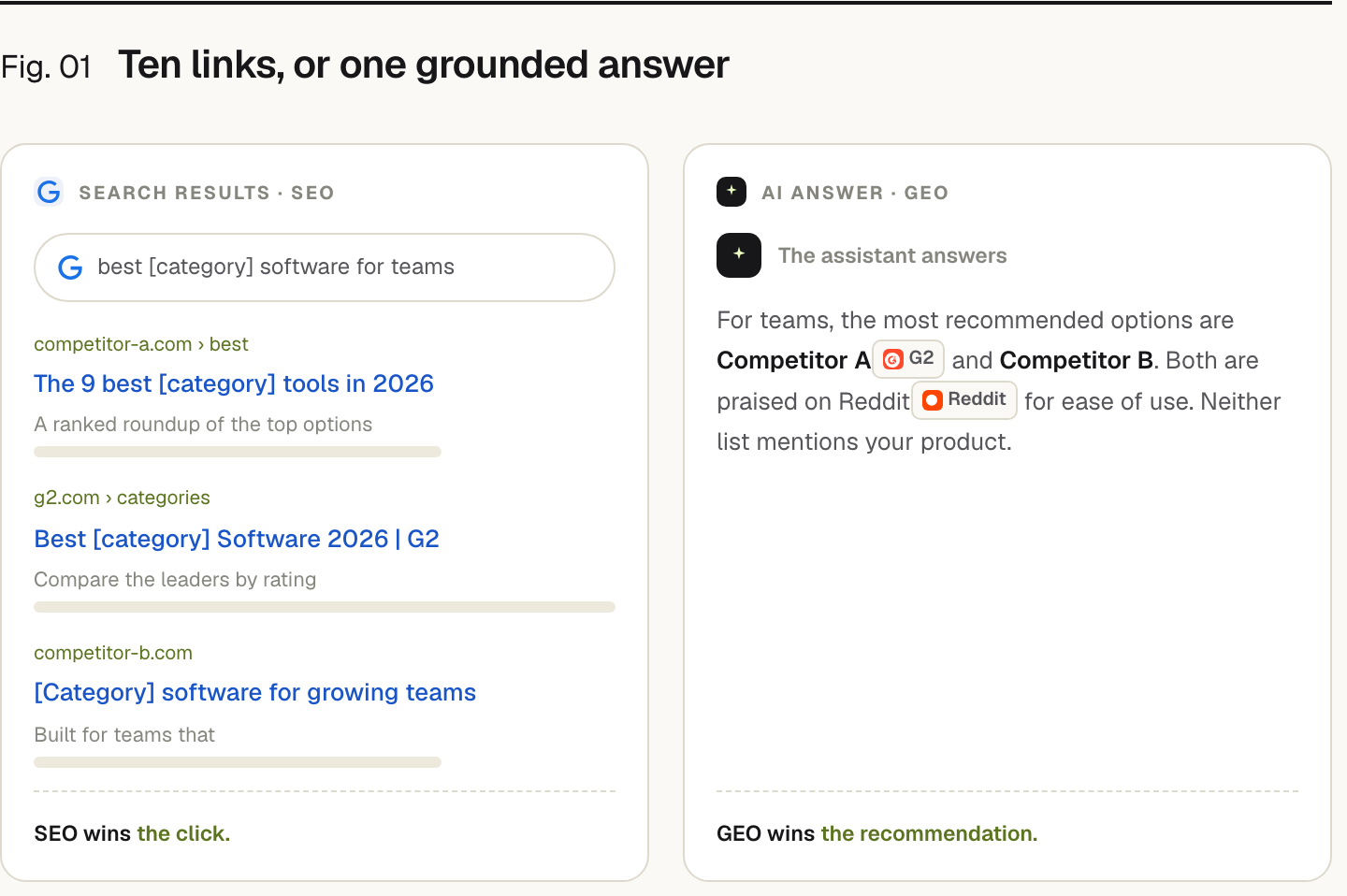
Gemini is one model on two surfaces#
The first thing to get straight is what “Gemini” means. Gemini is Google’s AI model, and it shows up in two different places: the Gemini app (the standalone assistant) and AI Overviews inside Google Search. Same model, different surfaces and different controls. Optimizing for one largely helps the other, because both ground in Google’s index, but as you will see, one control behaves differently between them.
How Gemini grounds an answer#
For a factual or current question, the Gemini app does not answer from memory alone. It grounds with Google Search: it issues a search, retrieves candidate pages from Google’s index, favors authoritative sources, and synthesizes an answer with citations to the pages it used. Its double-check feature can then validate individual statements against Search, highlighting what is corroborated.
The signals that get you grounded#
Because Gemini grounds in Google’s index and leans on Google’s quality signals, the signals that win a citation look like authoritative SEO aimed one layer deeper at the passage.
The Gemini checklist#
You can run this in an afternoon.
- Confirm indexation. Googlebot can crawl the page and it is indexed.
- Allow Google-Extended in robots.txt so Gemini can use your content.
- Answer first, with authority. A self-contained answer under each heading, backed by demonstrated expertise.
- Add schema and structure. FAQPage and Article, clean headings, lists.
- Earn corroboration. Get the claim confirmed across credible sources.
- Keep it fresh. Visible dates; refresh time-sensitive pages.
- Measure across engines. Track Gemini alongside ChatGPT, AI Overviews, Perplexity, and Claude.
Where measurement fits#
Gemini’s answers vary by query and grounding, so you cannot eyeball whether you appear. The reliable approach is to monitor a set of target questions on a schedule and record when Gemini cites you, across every engine, since Gemini, Google AI Overviews, ChatGPT, and Perplexity pull different sources for the same question. That cross-engine, honest measurement is what Visibly is built for. See the companion guides on how to appear in Google AI Overviews and how to get cited by Perplexity, or run a free AI visibility audit to see where you stand across all five surfaces today.
- How do I get my website into Google Gemini's answers?
- Is Gemini the same as Google AI Overviews?
- Does Google-Extended affect Gemini?
- How does Gemini decide which sources to cite?
- How is optimizing for Gemini different from SEO?
Frequently asked questions
How do I get my website into Google Gemini's answers?
Make sure Googlebot can crawl and index the page, allow Google-Extended so your content is eligible for grounding, and structure the page so the answer is easy to extract: a self-contained answer under a question-shaped heading, FAQPage or Article schema, visible dates, and authoritative, corroborated claims. When Gemini grounds a factual query with Google Search, it retrieves from the same index and favors trustworthy, well-structured sources.
Is Gemini the same as Google AI Overviews?
They share the same model but are different surfaces. Gemini is Google's AI model, available as the standalone Gemini app and assistant. AI Overviews are the generative summaries inside Google Search, also powered by Gemini. The optimization overlaps heavily because both ground in Google's index, but the controls differ: Google-Extended governs Gemini, while AI Overviews are part of Search and are not controlled by Google-Extended.
Does Google-Extended affect Gemini?
Yes. Google-Extended is the control that governs whether your content is used to improve and ground Gemini Apps and Vertex AI generative APIs. If you block Google-Extended, you opt out of being used by Gemini, though you remain in Google Search and can still appear in AI Overviews. This is the opposite of AI Overviews, where Google-Extended has no effect. If you want to appear in Gemini, allow Google-Extended.
How does Gemini decide which sources to cite?
For queries it grounds with Google Search, Gemini retrieves candidate pages from Google's index, favors authoritative and trustworthy sources (leaning on Google's quality signals), and synthesizes an answer with citations to the pages it used. Its double-check feature can validate individual statements against Search, which rewards claims that are corroborated across multiple credible sources over claims that appear in only one place.
How is optimizing for Gemini different from traditional SEO?
The foundation is the same: be indexed, be authoritative, be well-structured. The differences are that you optimize a passage to be grounded and cited rather than a page to rank, corroboration and demonstrated expertise matter more, and Google-Extended is an extra control that decides whether Gemini can use your content at all. The reader you are writing for is a model assembling a grounded answer, not only a human scanning results.
Does appearing in Gemini send traffic to my site?
It can. When Gemini grounds an answer, it shows citations to the sources it used, and users can click through to verify and read more. The traffic is less predictable than a classic search click, but a grounded citation is both visibility inside Gemini's answer and a path back to your page, across the many surfaces Gemini is embedded in.
Can I track whether Gemini cites my brand?
Yes. Because Gemini's answers vary by query and grounding, the reliable method is to monitor a set of target questions on a schedule and record when Gemini cites your brand or page, alongside the same prompts on ChatGPT, Google AI Overviews, Perplexity, and Claude. That cross-engine view is what a tool like Visibly measures, since each surface cites different sources for the same question.