How to get cited by Claude in 2026
A guide to getting cited by Claude: how its web search and citations work, why it favors verifiable sources, and a checklist you can run this week.

Claude answers from its training knowledge, and with web search on it retrieves live results and cites sources with links. To be citable, allow Anthropic's Claude-SearchBot and Claude-User crawlers, then earn it: Claude is accuracy-first, so it favors authoritative, verifiable, well-structured sources over marketing claims. Clear, specific, corroborated content wins the citation.
- Claude answers from its training knowledge, and when web search is enabled it retrieves live results and cites the sources it used with links.
- Anthropic's crawlers are distinct: ClaudeBot (training), Claude-SearchBot (indexing for Claude's web search), and Claude-User (fetching a page a user asked about). Allow the last two to be citable.
- Claude is accuracy-first and conservative, so it favors authoritative, verifiable, well-structured sources and is cautious about hype or unverified claims.
- Specific, named, corroborated facts beat vague marketing language. Claude tends to cite what it can verify across sources.
- As with every engine, passage-level answers, schema, and freshness make your content easier to extract and trust.
Claude answers from its training knowledge, and with web search on it retrieves live results and cites the sources it used with links. To be cited you have to be reachable by Anthropic’s crawlers, and then you have to earn it: Claude is accuracy-first, so it favors authoritative, verifiable, well-structured sources over marketing claims. This guide explains how Claude’s search and citations work, why it is more careful than some assistants, and a step-by-step checklist you can run this week.
How Claude reaches an answer#
Claude has two ways to answer. It can respond from its training knowledge, frozen at a cutoff, or, when web search is enabled, it can search the live web, retrieve current pages, and synthesize an answer with citations back to the sources it used. The web-search path is the one your site has leverage over, and the citations it produces are what put your page in front of the user.
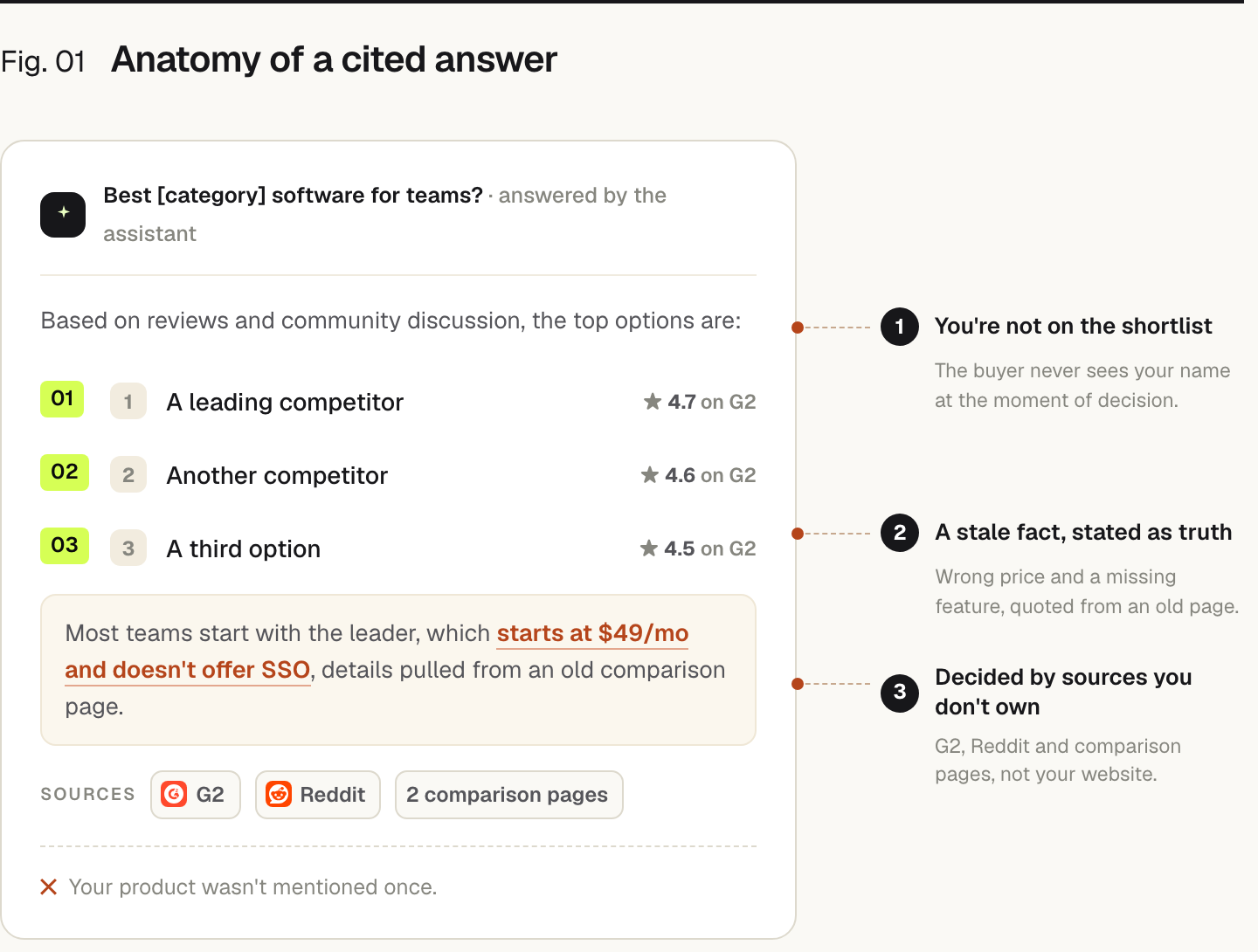
Why Claude is more careful about what it cites#
Claude is designed to be accuracy-first, and it shows in what it cites. It leans toward authoritative, well-structured, verifiable sources and is more reluctant than some assistants to repeat unverified or promotional claims. In practice, specific, named, corroborated facts get cited over vague marketing language.
The signals that get you cited by Claude#
The signals look like authoritative SEO, sharpened for a careful reader that is checking your claims.
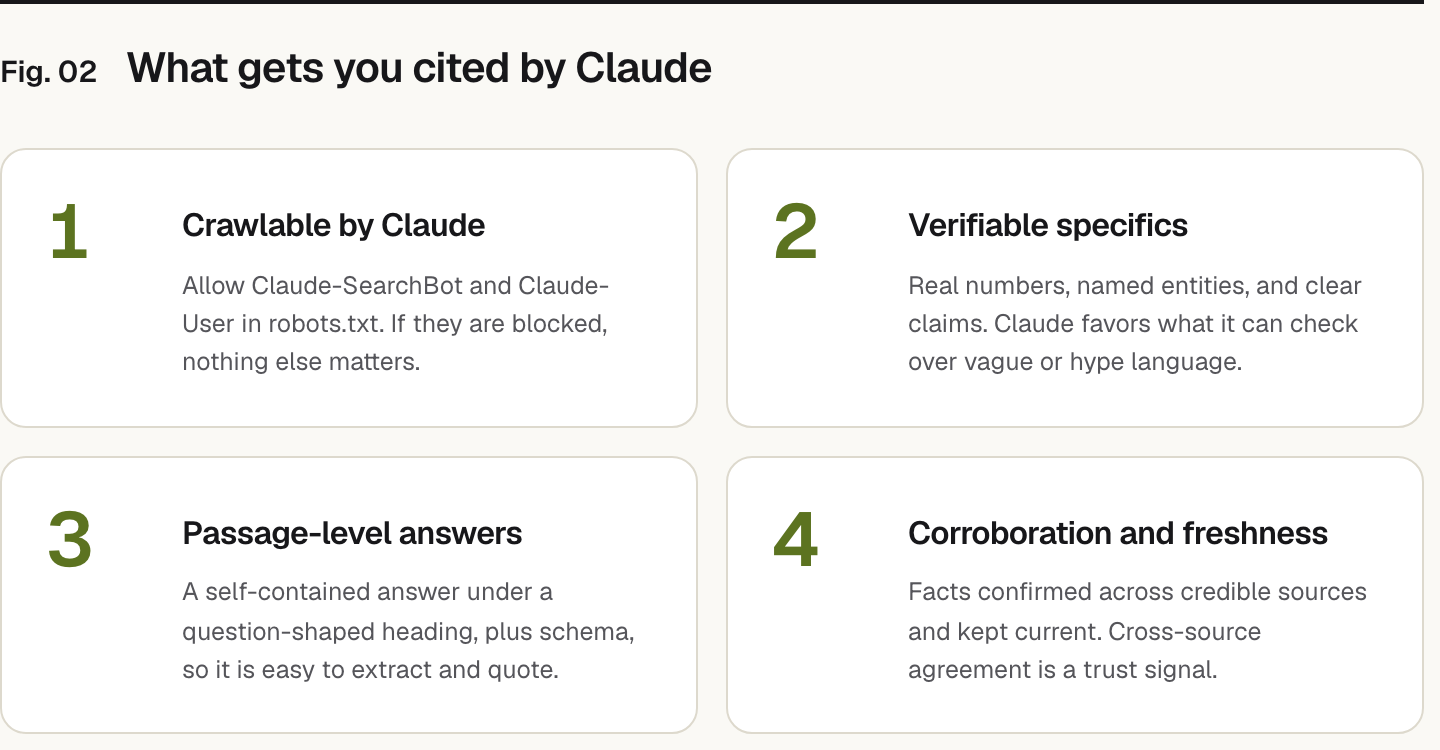
Specificity is the differentiator#
The place teams lose Claude citations is vagueness. A page that says a product is “the leading solution for teams” gives Claude nothing to verify; a page that states the price, the engines covered, and the named use case gives it facts it can check and quote. Write for a reader that is fact-checking you, because that is effectively what Claude is doing.
![The same question, 'what is the best [category] tool?', answered twice. Before the AEO work: the assistant recommends Competitor A (cited from G2) and Competitor B (praised on Reddit), and your brand is not mentioned. After the work: the assistant names Competitor A, Competitor B and your brand, now cited from a comparison guide.](/figures/claude-outcome.png)
The Claude checklist#
You can run this in an afternoon.
- Allow the crawlers. Claude-SearchBot and Claude-User in robots.txt.
- Answer first, factually. One self-contained, verifiable sentence under each heading.
- Be specific. Real numbers and named entities, not “leading” and “best-in-class.”
- Add schema and structure. FAQPage and Article, clean headings, lists.
- Earn corroboration. Get the facts confirmed on credible third-party sources.
- Keep it fresh. Visible dates; refresh time-sensitive pages.
- Measure across engines. Track Claude alongside ChatGPT, AI Overviews, Perplexity, and Gemini.
Where measurement fits#
Claude’s answers vary by query and whether web search runs, so you cannot eyeball whether you appear. The reliable approach is to monitor a set of target questions on a schedule and record when Claude cites you, across every engine, since Claude, ChatGPT, and Perplexity pull different sources for the same question. That cross-engine, honest measurement is what Visibly is built for. See the companion guides on how to get cited by Perplexity and how to appear in Google AI Overviews, or run a free AI visibility audit to see where you stand across all five surfaces today.
- How do I get my website cited by Claude?
- Does Claude have web search and can it cite sources?
- What web crawlers does Anthropic use?
- Why is Claude more careful about what it cites?
- How is optimizing for Claude different from Google SEO?
Frequently asked questions
How do I get my website cited by Claude?
Allow Anthropic's Claude-SearchBot and Claude-User crawlers in your robots.txt, then make your page easy to cite: open each section with a one-sentence, verifiable answer under a question-shaped heading, be specific and authoritative, add FAQPage or Article schema, keep it fresh, and earn corroboration on credible third-party sources. When Claude uses web search, it retrieves live results and cites the sources it trusts most for the question.
Does Claude have web search and can it cite sources?
Yes. Claude can search the web when the feature is enabled, retrieving live results and citing the sources it used with links, in addition to answering from its training knowledge. That means being crawlable and citable by Anthropic's search crawler is a prerequisite for appearing in those web-grounded answers, the same way it is for the other answer engines.
What web crawlers does Anthropic use?
Anthropic operates a few distinct crawlers. ClaudeBot is the general crawler associated with training data. Claude-SearchBot indexes the web to support Claude's web search. Claude-User fetches a specific page when a user asks Claude about it. To be eligible for Claude's web-search citations, allow Claude-SearchBot and Claude-User; ClaudeBot governs whether your content is used for training.
Why is Claude more careful about what it cites?
Claude is designed to be accuracy-first and cautious. In practice it favors authoritative, well-structured, verifiable sources and is more reluctant than some assistants to repeat unverified or hype claims. That means specific, named, corroborated facts tend to be cited over vague marketing language, so the content that wins is clear and defensible, not promotional.
How is optimizing for Claude different from Google SEO?
Traditional SEO optimizes a page to rank in a list. Optimizing for Claude optimizes a passage to be retrieved, trusted, and cited in a synthesized answer. Verifiability and specificity matter more, authoritative structure matters more, and Anthropic's crawlers are a separate access control. The reader you are writing for is a careful model assembling a cited answer, not a human scanning results.
Does appearing in Claude send traffic to my site?
It can. When Claude uses web search, it shows citations to the sources it drew on, and users can click through to read more. The traffic is less predictable than a classic search click, but a citation is both visibility inside Claude's answer and a link back to your page, and it signals the kind of authority that compounds across engines.
Can I track whether Claude cites my brand?
Yes. Because Claude's answers vary by query and whether web search runs, the reliable method is to monitor a set of target questions on a schedule and record when Claude cites your brand or page, alongside the same prompts on ChatGPT, Google AI Overviews, Perplexity, and Gemini. That cross-engine view is what a tool like Visibly measures, since each surface cites different sources for the same question.