Who gets cited in AI search: the best-documented product wins
We asked ChatGPT, Perplexity, Gemini and Claude 47 buyer questions across 8 industries and logged all 1,237 citations. 40% went to listicles, not vendors' own sites.

I asked ChatGPT, Perplexity, Gemini and Claude the same 47 buyer questions across 8 industries, with web search on, and logged all 1,237 citations. 40% went to independent best-X listicles, ahead of the vendors' own sites at 34%. Only 5 domains were cited by all four engines, Perplexity produced 65 of the 75 Reddit and YouTube citations, and ChatGPT skipped live search on 29 of 47 answers.
- AI recommends the best-documented product, not the best one: 40% of the 1,237 citations went to independent listicles, ahead of the vendors' own sites at 34%.
- The engines barely share sources: of 713 distinct domains, only 5 were cited by all four, and about 75% were cited by a single engine.
- Only Perplexity reads community and video, producing 65 of the study's 75 Reddit and YouTube citations; Claude cited neither once.
- ChatGPT skipped live web search on 29 of its 47 answers and replied from memory, so it cites vendor sites least (23%).
- The winning play flips by industry: 5 of 8 are listicle-led, but HR, finance and support are vendor-led, where your own comparison pages get cited.
“Best CRM for a small team.”
A buyer types that into ChatGPT right now. Four seconds later they have a shortlist of three tools. Maybe they buy one this quarter.
Here is the uncomfortable part: that shortlist was not built from your website. It was built from whoever wrote about your website.
I wanted to know exactly how this works, so I ran an experiment. I asked ChatGPT, Perplexity, Gemini and Claude the same 47 questions real buyers ask, across 8 industries, with web search turned on. Then I logged every single source they cited. All 1,237 of them.
One pattern changed how I think about marketing in 2026: AI is not recommending the best product. It is recommending the best-documented one.
Here is the full study, the findings, and the exact playbook it implies.
Why I ran this#
Every marketing team I talk to is asking the same question: “Are we visible in AI search yet?” And almost nobody can answer it with data. They have a gut feeling, a screenshot of one ChatGPT answer, and a lot of anxiety.
That is a bad way to spend a budget. So instead of guessing, I ran a measured study of what the four biggest AI models actually cite when someone asks them to recommend a tool. Not what the models say they do. What they did, on 188 real answers, logged and classified one citation at a time.
It cost about ten dollars and a day of compute. What it showed was worth a lot more than that.
How the study worked#
I took 47 buyer questions across 8 industries, the mix of “best X” and “X vs Y” queries people actually type. I ran each one through ChatGPT, Perplexity, Gemini and Claude with live web search forced on, which produced 188 answers. Then I pulled every cited source out of every answer, normalized it to its root domain, and classified it by type: an independent listicle, a vendor’s own site, a media or SaaS blog, a Reddit thread, a review site, or a YouTube video.
That gave me 1,237 citations across 713 distinct domains. The full methodology and every caveat are at the bottom, and yes, there are real caveats. But first, the five things the data made obvious.
Finding 1: The lists win, not the brands#
The single biggest source of AI citations was not any brand’s website. It was independent “best tools” listicles.
40% of all 1,237 citations went to third-party roundup articles. Only 34% went to the vendors’ own sites. Media and SaaS blogs took another 15%, and Reddit, review sites and YouTube took roughly 3 to 4% each.
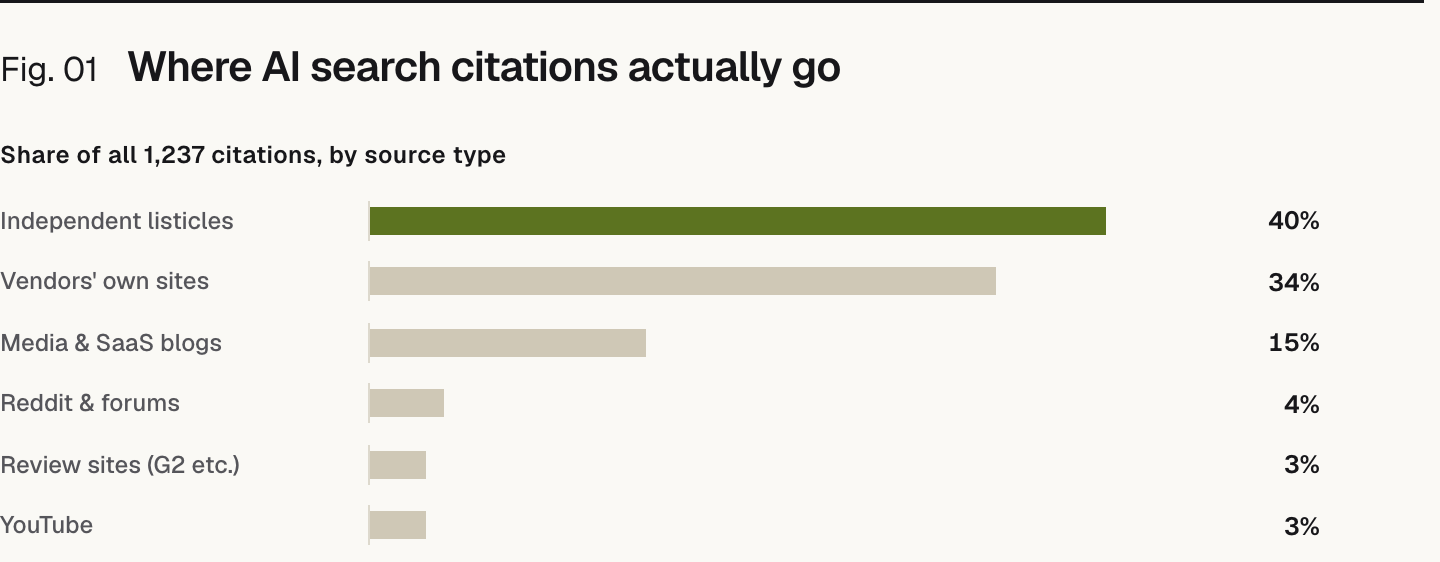
Sit with that for a second. The affiliate-driven “10 best CRMs in 2026” article that every marketer quietly resents is now a primary feedstock for AI answers. When a model assembles a recommendation, it reaches for the neutral third party writing about the category more often than it reaches for the companies in the category.
Finding 2: The four engines barely agree#
If you think of “AI search” as one thing you can win, the data disagrees hard.
Of the 713 distinct domains cited, only 5 were cited by all four engines (zapier.com, g2.com, forbes.com, thedigitalprojectmanager.com, and getaleph.com). Everything else was fragmented. About 75% of domains were cited by a single engine and no other.
The engines even pull from different-sized pools. ChatGPT drew from 89 distinct domains across the study, Perplexity from 273, Gemini from 367, and Claude from 220. Same questions, wildly different reading lists.
Finding 3: Only Perplexity reads the room#
We tell people that community and video presence matters for AI search. The data says it matters on exactly one engine.
Perplexity produced 65 of the 75 Reddit and YouTube citations in the entire study (37 from Reddit, 28 from YouTube). Claude cited neither, not once. ChatGPT cited them a single time. Gemini a handful.
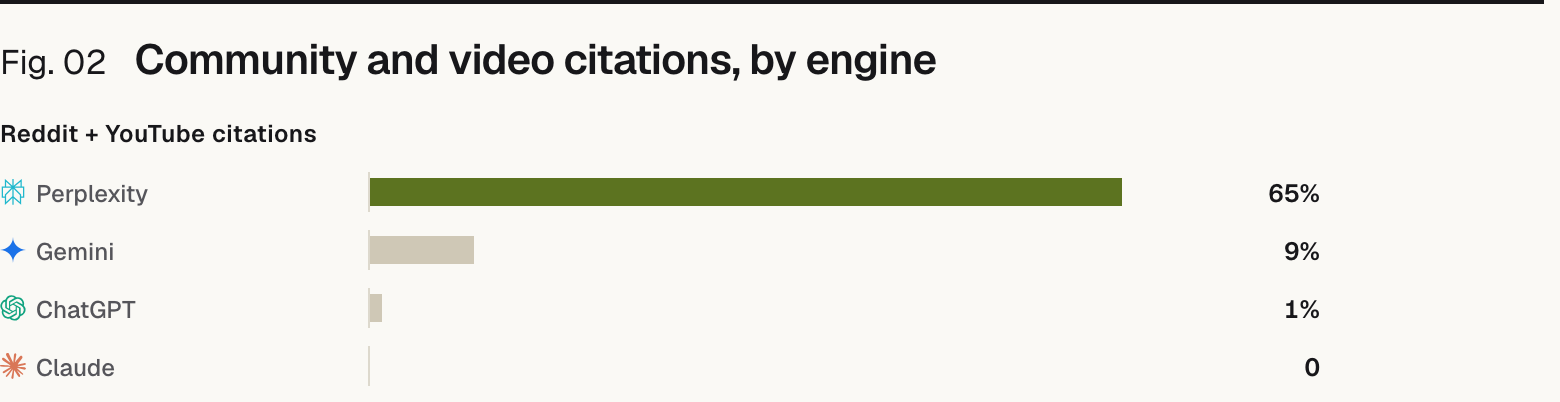
So if you are investing in Reddit threads and YouTube walkthroughs to show up in AI, understand what you are buying: real leverage on Perplexity, and almost nothing on the other three. That is not a reason to skip it. It is a reason to be honest about where it pays off.
Finding 4: ChatGPT often does not even look#
Here is the finding I did not expect. ChatGPT skipped live web search on 29 of its 47 answers. It just answered from memory, citing nothing at all.
That is why ChatGPT cites vendor sites least of the four (23%, versus 34 to 36% for the others). It is not that ChatGPT dislikes vendor pages. It frequently is not reading any live page.
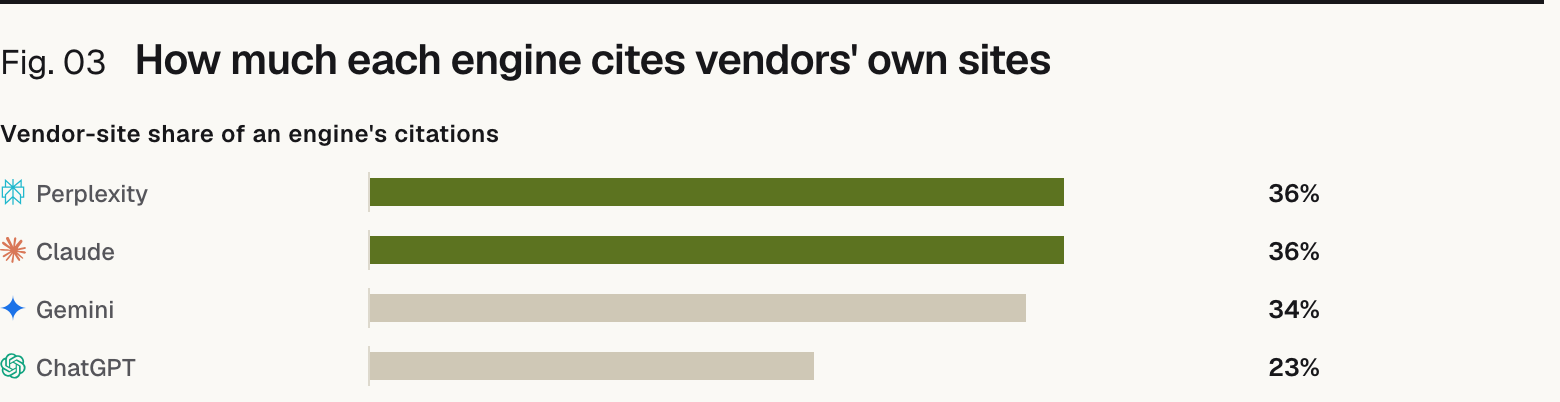
The implication is strategic. For ChatGPT, a big part of the game is not “is my page crawlable today.” It is “is my brand in the model’s memory at all.” That is a slower, harder thing to earn than a fresh blog post, and it rewards brands that have been consistently talked about for a long time.
Finding 5: It splits by industry#
This is the finding that turns the study from interesting into useful. The pattern is not the same everywhere. It flips by category.
In 5 of the 8 industries, listicles dominate: marketing (44%), CRM and sales (41%), project management (49%), ecommerce (40%), and SEO and AI tools (47%). In these markets, getting into the third-party roundups is the whole game.
But in 3 industries the vendors’ own sites win: HR and recruiting (45%), accounting and finance (41%), and customer support (39%). In these, your own comparison and pricing pages actually get cited, because the roundup ecosystem is thinner and the models fall back on the source of record.
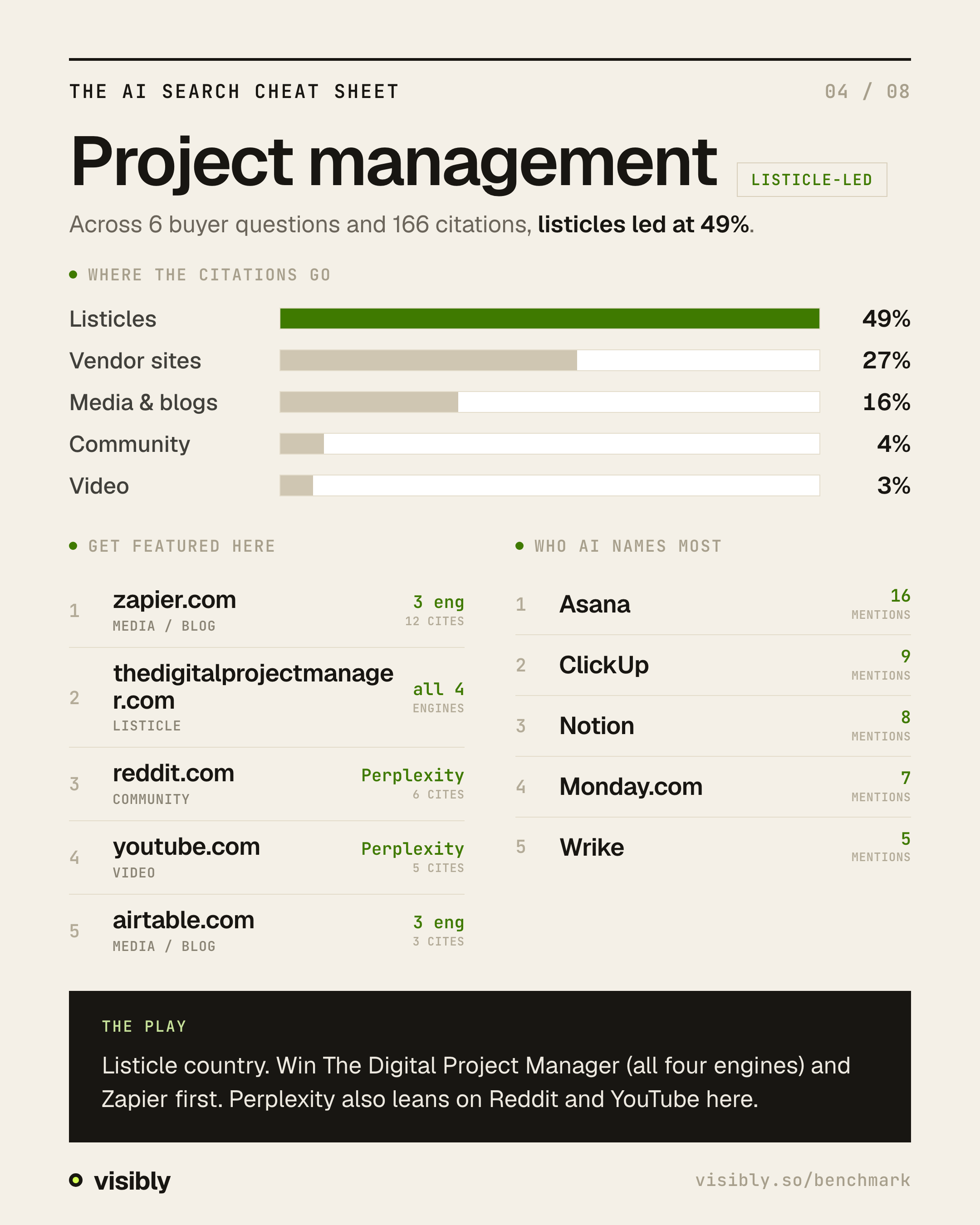
Same four engines, same method, opposite playbook depending on your category. If you run marketing for an HR platform and you copy the content strategy of a project-management tool, you will spend a year optimizing for the wrong thing. We published a free cheat sheet for all 8 industries, with the exact publishers to get featured in and the brands AI already names.
The scoreboard: who AI trusts most right now#
Two lists, straight from the data.
The 15 most-cited sources across the study:
| # | Source | Citations |
|---|---|---|
| 1 | reddit.com | 43 |
| 2 | youtube.com | 32 |
| 3 | zapier.com | 31 |
| 4 | g2.com | 19 |
| 5 | salesforce.com | 13 |
| 6 | techradar.com | 12 |
| 7 | monday.com | 11 |
| 8 | forbes.com | 10 |
| 9 | emailvendorselection.com | 9 |
| 10 | guideflow.com | 9 |
| 11 | hubspot.com | 8 |
| 12 | peoplemanagingpeople.com | 8 |
| 13 | technologyadvice.com | 8 |
| 14 | emailtooltester.com | 7 |
| 15 | marketermilk.com | 7 |
The 15 brands AI recommended most:
| # | Brand | Recommendations |
|---|---|---|
| 1 | HubSpot | 22 |
| 2 | Zendesk | 17 |
| 3 | Gusto | 16 |
| 4 | Asana | 16 |
| 5 | BambooHR | 14 |
| 6 | Ahrefs | 13 |
| 7 | Pipedrive | 13 |
| 8 | Rippling | 13 |
| 9 | Surfer SEO | 13 |
| 10 | Notion | 12 |
| 11 | SE Ranking | 12 |
| 12 | Semrush | 12 |
| 13 | Shopify | 10 |
| 14 | Zoho Desk | 10 |
| 15 | ClickUp | 10 |
Look at the top of the first list. Reddit, YouTube, Zapier, G2. The sources AI leans on hardest are not any single brand’s marketing site. They are the shared infrastructure of the internet writing about brands.
What to actually do about it#
Five moves, in order of leverage:
- Get into the credible third-party roundups in your category. They are the single biggest source of citations. Outreach to the real “best X” lists that rank in your space is higher-leverage than most of the on-page work you are doing right now.
- Track every engine, not one. With only 5 of 713 domains shared across all four, a win on one is not a win on another. Measuring a single model is measuring a quarter of the picture.
- Use Perplexity for community and video bets. Reddit and YouTube move Perplexity and almost nothing else. Spend there with clear eyes.
- Answer “vs” questions with neutral, well-sourced comparisons. On head-to-head “X vs Y” queries, vendor sites were only 18% of citations, versus 37% on “best tool” queries. The moment a buyer pits two brands against each other, the models reach for a neutral referee. Be useful enough to be that reference.
- Find your category’s pattern before you spend a dollar. Listicle-led or vendor-led changes everything. Do not copy a playbook from a different industry.
Methodology and the honest caveats#
Here is exactly what I did, so you can trust the numbers or poke holes in them.
On 2026-07-10, I sent 47 buyer questions across 8 industries (SEO and AI tools, marketing, CRM and sales, project management, HR and recruiting, accounting and finance, customer support, and ecommerce) to four engines through the DataForSEO LLM API, with web search enabled on every call: ChatGPT (gpt-4o), Perplexity (sonar-pro), Gemini (gemini-2.5-pro), and Claude (claude-sonnet-4-5). That produced 188 answers. From each, I extracted every cited source URL, normalized it to its root domain, and classified it into one source type. The counts above are of those 1,237 citations. Every aggregate was re-verified against the raw data before publishing.
Sources and references#
- Primary data: the Visibly AI Citation Study, run 2026-07-10. Explore every slice, by engine and by industry, on the interactive Visibly Index, and get the per-industry cheat sheets.
- Engines and models queried (via the DataForSEO LLM Response API, web search on): ChatGPT (gpt-4o), Perplexity (sonar-pro), Gemini (gemini-2.5-pro), Claude (claude-sonnet-4-5).
- Most-cited third-party sources referenced above: reddit.com, youtube.com, zapier.com, g2.com, techradar.com, forbes.com, technologyadvice.com, thedigitalprojectmanager.com, emailvendorselection.com, marketermilk.com.
- Further reading: How to show up in AI search for the playbook this data implies.
To see where AI cites you today, run a free AI visibility audit.
- What kind of content gets cited most in AI search?
- Do ChatGPT, Perplexity, Gemini, and Claude cite the same sources?
- Which AI engine cites Reddit and YouTube the most?
- Do AI engines cite vendors' own websites?
Frequently asked questions
What kind of content gets cited most in AI search?
Across 8 industries, independent third-party listicles ('best X in 2026' roundups) were the single biggest source: 40% of all 1,237 citations went to roundup blogs, versus 34% to the vendors' own sites, 15% to established media and large SaaS blogs, and roughly 3 to 4% each to Reddit, review aggregators like G2, and YouTube. The practical read: being featured in credible third-party roundups matters more than any single page on your own site.
Do ChatGPT, Perplexity, Gemini, and Claude cite the same sources?
Almost never. Of the 713 distinct domains cited across the four engines, only five (zapier.com, g2.com, forbes.com, thedigitalprojectmanager.com, and getaleph.com) were cited by all four, and about 75% of domains were cited by only a single engine. Winning a citation on one engine is close to no guarantee of winning it on another.
Which AI engine cites Reddit and YouTube the most?
Perplexity, by a wide margin. It produced 37 of the study's Reddit citations and 28 of the YouTube citations, 65 of the 75 total. Claude cited neither even once, ChatGPT once, and Gemini a handful of times. If community and video presence is part of your strategy, Perplexity is where it pays off most directly.
Do AI engines cite vendors' own websites, or third parties?
Both, but third parties lead. Across all engines, vendors' own sites were 34% of citations, just behind independent listicles at 40%. Three engines cite vendor sites at a similar rate (Perplexity 36%, Claude 36%, Gemini 34%); ChatGPT is the outlier at 23%, partly because it skipped web search on 29 of 47 answers. On 'X vs Y' questions vendor sites fell to 18%; on 'best tool' questions they matched listicles at 37%.