How to show up in AI search in 2026
How to show up in AI search across ChatGPT, Google AI Overviews, Perplexity, Gemini, and Claude: the shared foundation, what differs per engine, and a checklist.

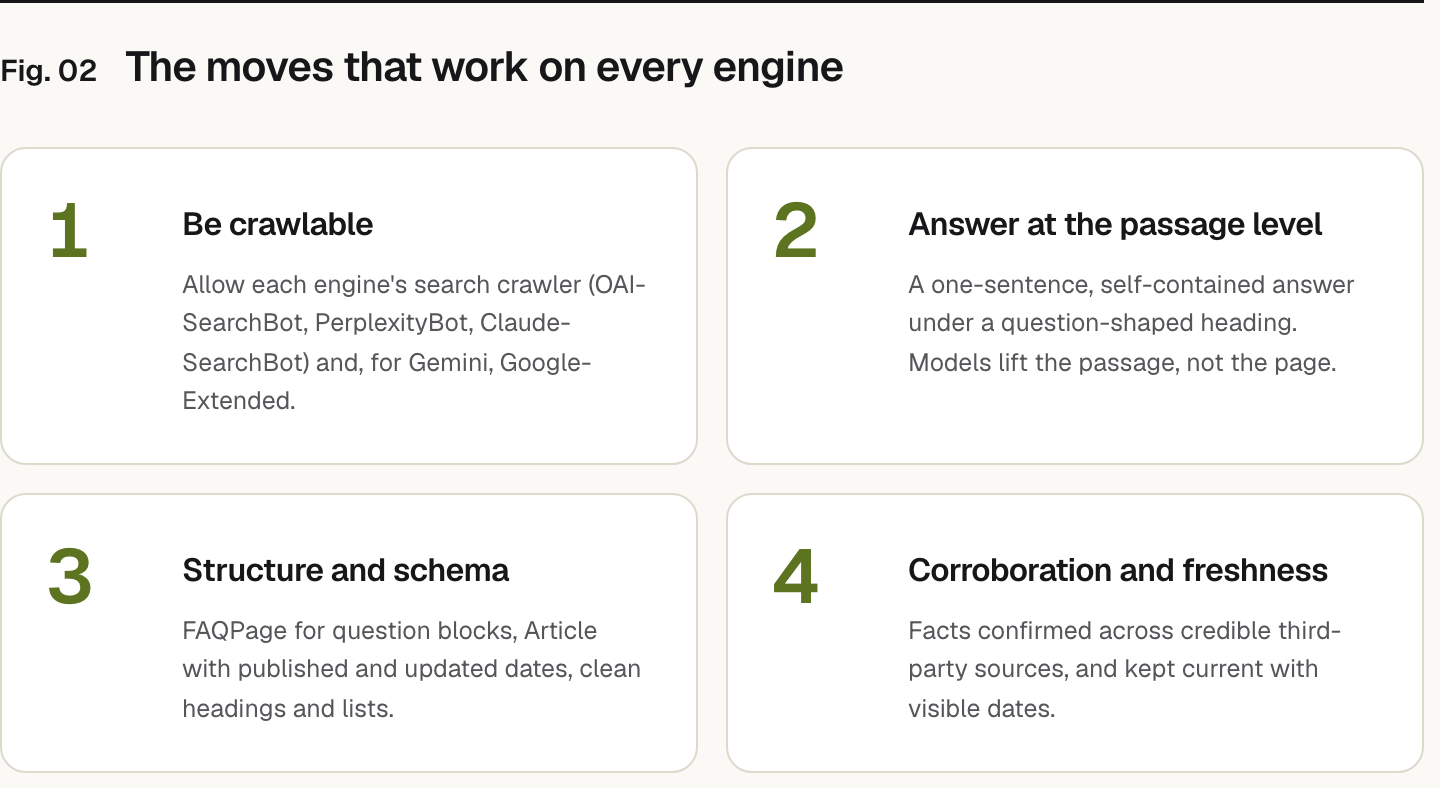
Showing up in AI search means being cited when people ask ChatGPT, Google AI Overviews, Perplexity, Gemini, and Claude, not just ranking on Google. The foundation is shared: be crawlable, answer at the passage level, add schema, earn corroboration, and stay fresh. What differs is the access control per engine, which crawler to allow and, for Gemini, whether to allow Google-Extended.
- AI search is five surfaces, not one: ChatGPT, Google AI Overviews, Perplexity, Gemini, and Claude, and each cites different sources for the same question.
- The foundation is shared across all of them: be crawlable, answer at the passage level, add schema, earn corroboration off-page, and keep content fresh.
- What differs per engine is mostly the access control: which crawler to allow (OAI-SearchBot, PerplexityBot, Claude-SearchBot) and, for Gemini, whether to allow Google-Extended.
- Being cited off-page matters as much as your own page: AI answers are built from review sites, community threads, and comparison pages, not just your site.
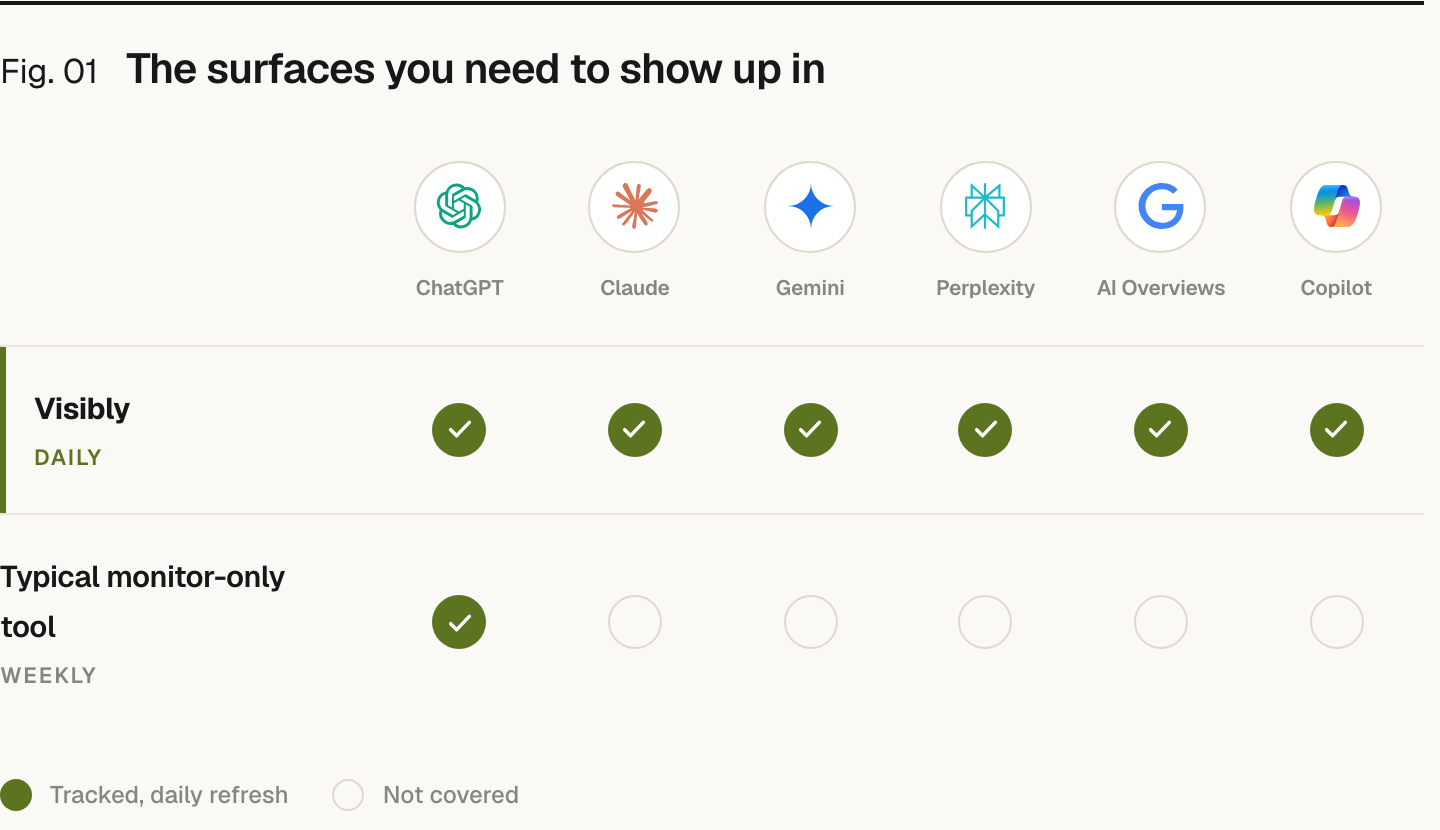
- Because each surface cites differently, single-engine tracking is misleading; measure across all five.
Showing up in AI search means being cited when people ask ChatGPT, Google AI Overviews, Perplexity, Gemini, and Claude, not just ranking on Google. The foundation is shared across all five, so most of the work counts everywhere. What differs is mostly the access control per engine. This guide covers the shared playbook, what changes per engine (with a dedicated guide for each), and a checklist you can run this week.
AI search is five surfaces, not one#
A single question, “what is the best CRM for small teams”, is answered differently by each engine, and each cites different sources. Being visible in AI search means being one of the cited sources across all of them, not just ranking on Google. So the first shift is to stop thinking about one results page and start thinking about five synthesized answers.
The shared foundation#
Here is the good news: the same five moves work on every engine. Get these right and you are eligible for citations everywhere.
Because AI answers are built from third-party sources as much as your own, some of this is off-page work: being present and consistent in the review sites, community threads, and comparison pages that models trust.
Where the engines differ#
The foundation is shared, but each engine has a specific lever. Each has its own guide.
- ChatGPT: allow
OAI-SearchBot; it reaches answers through training, live Bing browsing, and its own ChatGPT Search index. - Google AI Overviews: win a passage in the query fan-out; AI Overviews are part of Search, so Google-Extended does not apply.
- Perplexity: allow
PerplexityBot; it searches live, cites prominently (real referral traffic), and weights community sources heavily. - Gemini: allow Google-Extended (it governs Gemini Apps, unlike AI Overviews); it grounds factual answers with Google Search.
- Claude: allow
Claude-SearchBot; it is accuracy-first and favors specific, verifiable, corroborated facts over marketing language.
The AI search checklist#
You can run this in an afternoon, and it counts on every engine.
- Allow the AI crawlers (OAI-SearchBot, PerplexityBot, Claude-SearchBot) and Google-Extended for Gemini.
- Answer first. One self-contained sentence under each question-shaped heading.
- Be specific. Real numbers and named entities, not vague superlatives.
- Add schema and structure. FAQPage and Article, clean headings, lists.
- Earn corroboration. Get your claim onto credible third-party sources.
- Keep it fresh. Visible dates; refresh time-sensitive pages.
- Measure across all five engines, since each cites different sources.
Where measurement fits#
You cannot improve what you cannot see, and AI answers vary by query, engine, and session. The reliable approach is to monitor a set of target questions on a schedule and record when each engine cites you, across all five surfaces at once. That cross-engine, honest measurement is what Visibly is built for. Start with the per-engine guides above, read what GEO is and what AEO is, or run a free AI visibility audit to see exactly where you stand across every model today.
- How do I show up in AI search results?
- What is the difference between AI search and Google search?
- Which AI engines should I optimize for?
- How is optimizing for AI search different from SEO?
- How do I track my brand in AI search?
Frequently asked questions
How do I show up in AI search results?
Make your pages crawlable by the AI search crawlers, answer questions at the passage level (a self-contained answer under a question-shaped heading), add FAQPage and Article schema, earn corroboration on credible third-party sources, and keep content fresh. Then do it for each engine's access control: allow OAI-SearchBot, PerplexityBot, and Claude-SearchBot, and allow Google-Extended for Gemini. AI answers cite the clearest, most current, best-corroborated source for the question.
What is the difference between AI search and Google search?
Traditional Google search returns a list of links to choose from. AI search returns one synthesized answer with a few cited sources. You are no longer optimizing to rank in a list of ten; you are optimizing to be one of the handful of sources the model trusts enough to quote. Ranking still helps, but passage-level extractability and corroboration decide the citation.
Which AI engines should I optimize for?
The five that matter in 2026 are ChatGPT, Google AI Overviews, Perplexity, Gemini, and Claude. The good news is the foundation is shared, so most of the work counts everywhere. The per-engine differences are mainly access controls (which crawler to allow) and a few specifics, like Perplexity's heavy weighting of community sources and Gemini's Google-Extended control.
How is optimizing for AI search different from SEO?
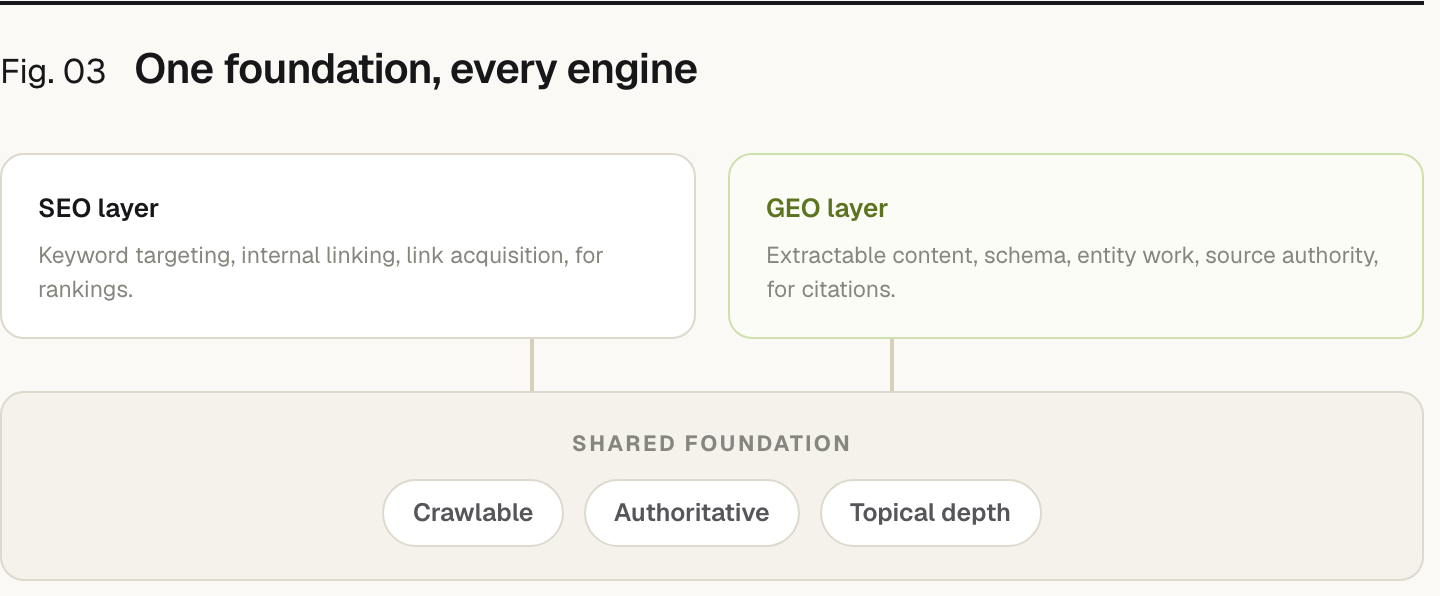
SEO optimizes a page to rank; AI search optimization (often called GEO or AEO) optimizes a passage to be extracted and cited in a synthesized answer. It shares the SEO foundation, crawlable, authoritative, well-structured, but emphasizes answer-first writing, schema, corroboration across sources, and freshness. The reader you are writing for is a model assembling a cited answer, not only a human scanning results.
How do I track my brand in AI search?
Because AI answers vary by query, engine, location, and session, the reliable method is to monitor a set of target questions on a schedule and record when each engine cites your brand or page. Track all five surfaces together, since ChatGPT, AI Overviews, Perplexity, Gemini, and Claude pull different sources for the same question. That cross-engine measurement is what Visibly is built for.
Do I need to be on Reddit and review sites to show up in AI search?
Often, yes. AI answers are built as much from third-party sources, review grids like G2, Reddit and forum threads, and comparison pages, as from your own site, especially for recommendation and comparison queries. Being present and consistent in those sources is part of showing up, which is why AI search is partly on-page and partly off-page work.