Is Your Category Listicle-Led or Vendor-Led in AI Search?
In 5 of 8 industries, AI citations go to third-party listicles; in 3, vendors' own sites win. Two plays to classify your category and build your gap list.

Your category classified as listicle-led or vendor-led (with the shares that prove it), and your gap list started: the exact domains AI cites in your category instead of you. Plays 08 and 09.
AI citation patterns flip by industry. In our study of 1,237 citations, independent listicles led in 5 of 8 industries, taking up to 49% of citations, but in HR, finance, and customer support the vendors' own sites won. Classify your category before you spend anything: the verdict decides whether your next 90 days go to third-party outreach or to your own comparison pages.
- Listicles lead AI citations in 5 of 8 industries measured: project management (49%), SEO and AI tools (47%), marketing (44%), CRM and sales (41%), and ecommerce (40%).
- Vendors' own sites lead in HR and recruiting (45%), accounting and finance (41%), and customer support (39%), where the roundup ecosystem is thinner.
- On 'X vs Y' questions, vendor sites fell to 18% of citations; on 'best tool' questions they took 37%. The question type changes the winner.
- Copying a playbook from a different industry is the most expensive mistake in AEO: the same budget can go to exactly the wrong surface.
The most useful cut in our citation data is the one almost nobody checks: the winning surface flips by industry. In 5 of the 8 industries we measured, independent listicles dominate AI citations. In the other 3, the vendors’ own sites win. Same four engines, same method, opposite playbook. If you run marketing for an HR platform and copy the content strategy of a project-management tool, you will spend a year optimizing for the wrong surface.
This chapter gives you the two-hour measurement that prevents that: classify your category, then turn the same data into your gap list, the named domains earning your citations today. Both artifacts feed every later chapter.
The two patterns#
Across the whole study, listicles led vendors’ own sites 40% to 34%. But the average hides the split.
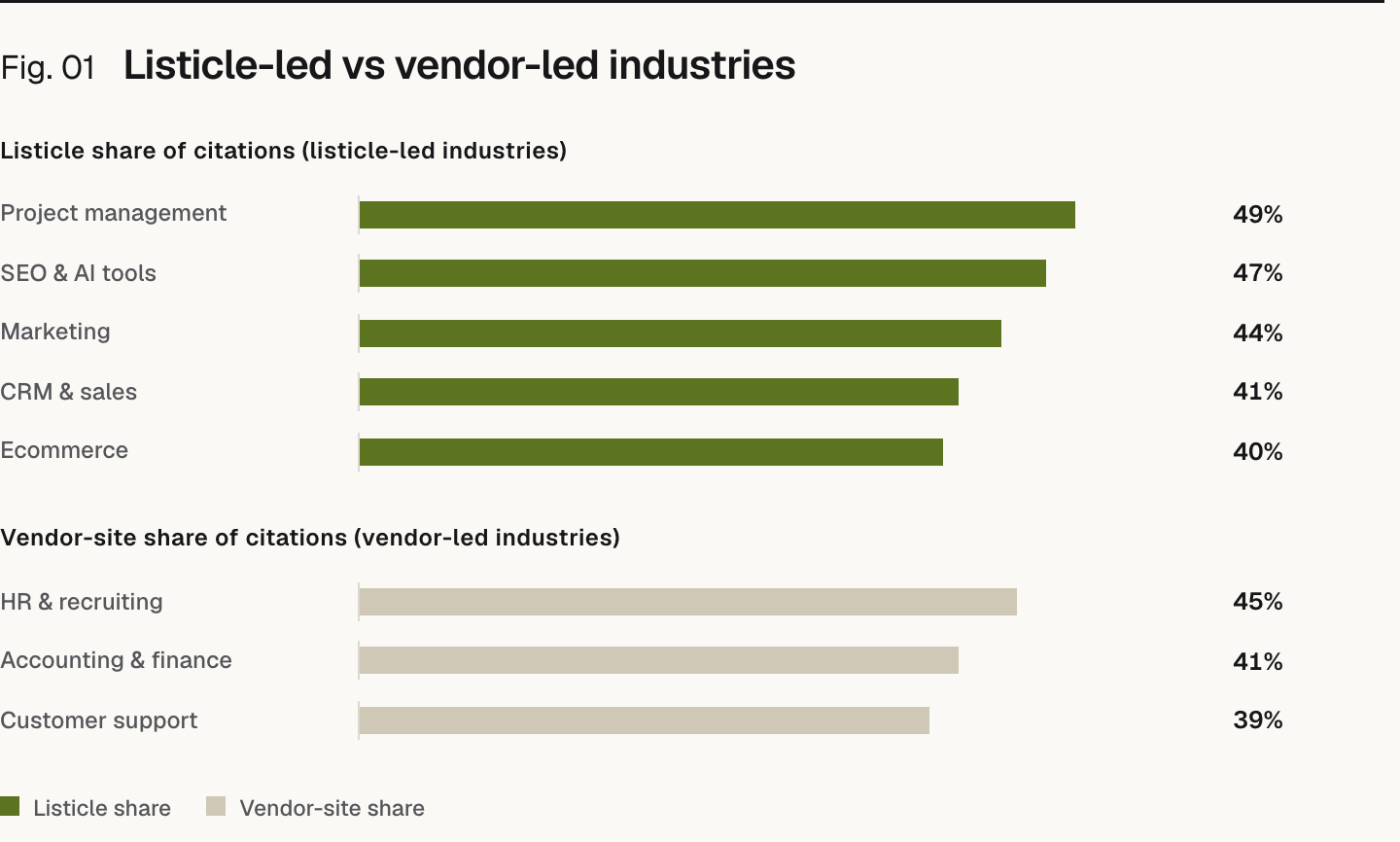
In a listicle-led category, the citation game is won on other people’s websites. The engines assemble their recommendations from the “best tools” roundups written about your market, so presence in those lists outweighs anything you publish yourself. The off-page chapter is your main event.
In a vendor-led category, your own pages get cited. Fewer independent lists cover HR, finance, and support tooling, so the models fall back on the companies’ own comparison pages, pricing pages, and documentation. Here your own site carries more of the load, and off-page work supports it.
The question type changes the winner too#
The industry pattern has a second axis: what kind of question the buyer asks.
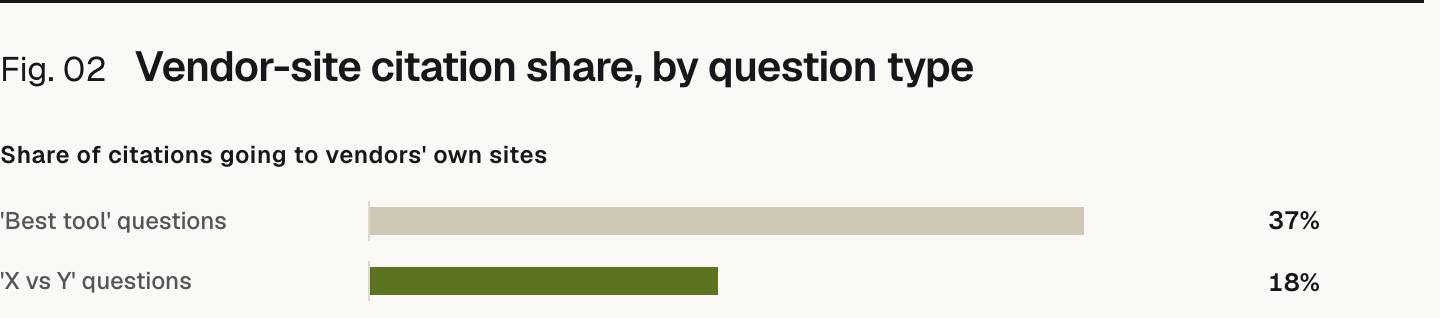
On “best tool” questions, vendor sites held 37% of citations, level with listicles. On “X vs Y” questions, vendor sites fell to 18%. The moment a buyer pits two brands against each other, the models reach for a neutral referee. Even in a vendor-led category, your head-to-head comparison pages compete with neutral sources, which is why the honest, criteria-driven comparison format shows up again in the content chapter.
The plays#
Two plays, about three hours total, and you have the verdict plus the target list every later chapter uses.
Classify your category as listicle-led or vendor-led
Measure which surface wins citations in your market, so the rest of your AEO budget goes to the right column.
In our study the winning surface flipped by industry: listicles took 49% of citations in project management, while vendors' own sites led HR at 45%. A playbook copied across that line targets the wrong surface entirely. (Visibly AI Citation Study, checked 2026-07-10)
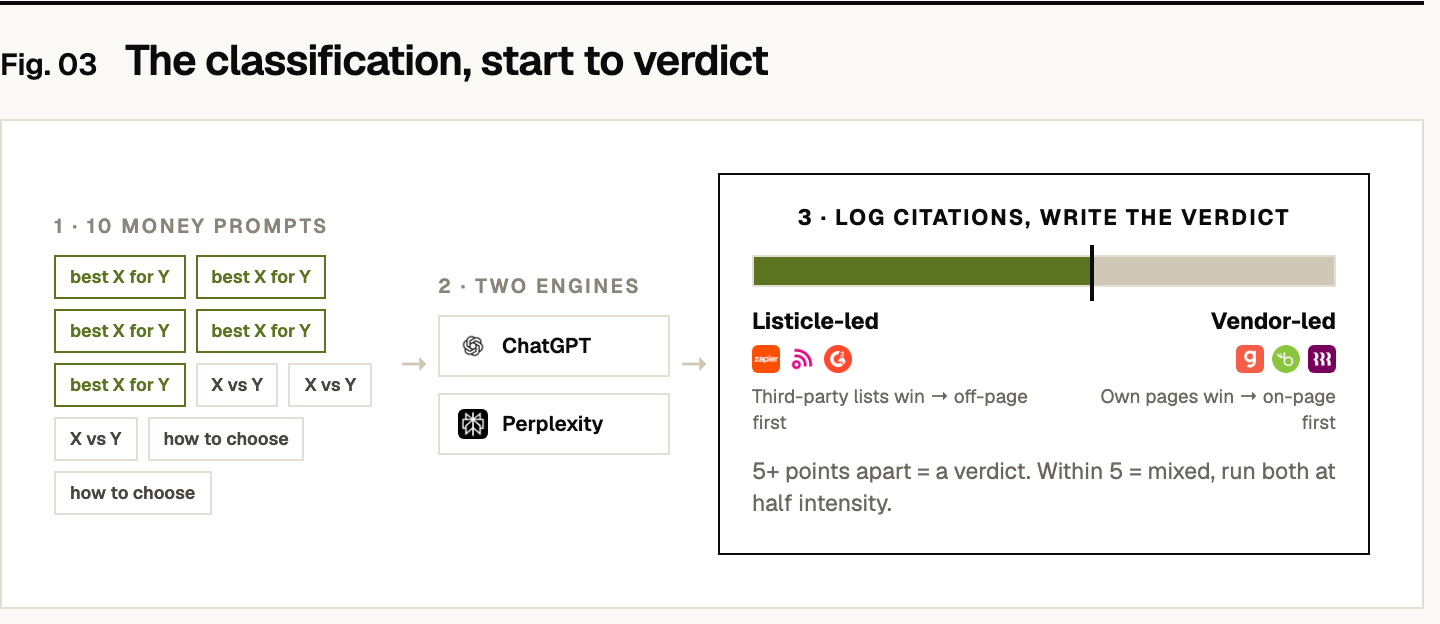
- Write your 10 money prompts: five 'best [category] for [your buyer]', three '[you] vs [rival]' or '[rival] vs [rival]', two 'how do I choose a [category]'.
- Run each prompt in ChatGPT and in one engine that searches the web and cites sources (Perplexity cites the most), and save every answer.
- Log every cited source and classify it: independent listicle, vendor's own site, media or SaaS blog, Reddit or forum, review site, video.
- Compute the share of citations per type.
- Write the verdict: listicle share beats vendor share by 5+ points, you are listicle-led; vendor leads, you are vendor-led; within 5 points, treat it as mixed and run both playbooks at half intensity.
Done when: A written verdict with the shares that produced it, saved next to the answer logs.
Verify it worked: Re-run the same 10 prompts monthly. The verdict is stable once two consecutive runs agree; if they disagree, your category is mixed or moving, which is worth knowing early.
Common failure mode: Sampling only ChatGPT. It answered 29 of 47 questions from memory in our study, and a memory answer tells you nothing about which pages get cited. Always include an engine that searches and cites, like Perplexity.
Build your gap list
Turn the same answer logs into a ranked list of the domains earning the citations you want.
Every domain AI cites in your category that is not you is a mapped, addressable gap. Our own gap list from this exact exercise became our outreach queue: the domains the engines cite for our category, none of which mentioned us, are now the targets of our pitching.
Before you start: Play 08's answer logs.
- From the Play 08 logs, list every cited domain that is not yours.
- Count how many prompts and engines each domain appeared in; recurrence is the rank.
- Tag each domain by surface type: listicle, review site, directory, community, media.
- Rank by recurrence times accessibility (a niche roundup answers email; a national newspaper mostly does not).
- Keep the top 20. That is the seed of your off-page target list in the off-page chapter.
Done when: 20 ranked domains, each with a surface type and a recurrence count.
Verify it worked: Each month, count how many gap-list domains now mention or cite you. That number rising is off-page AEO working.
Common failure mode: Building the list and filing it away. The gap list is not a report, it is the to-do queue; every row should route to a play.
Real examples: same method, opposite winners#
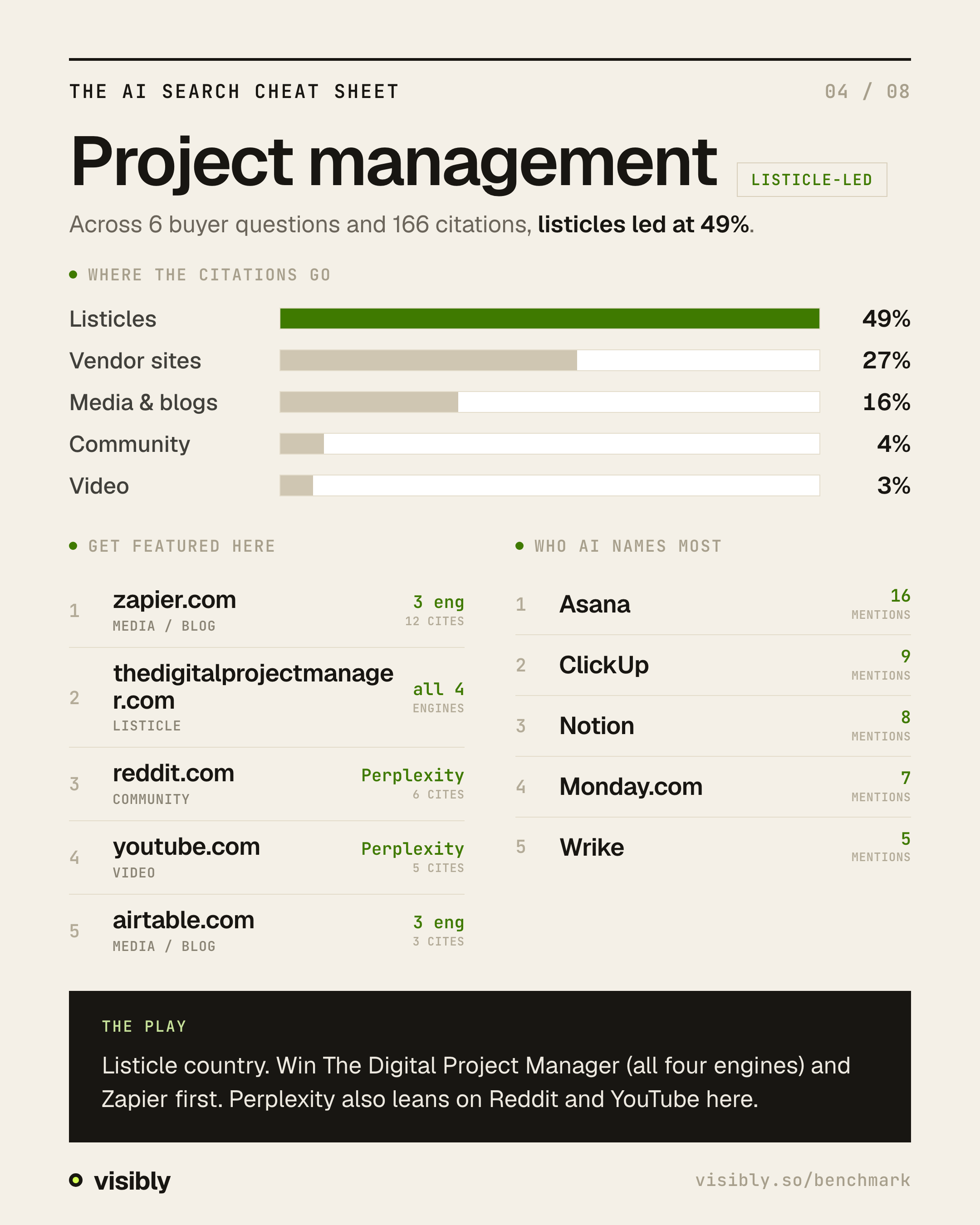
Project management (listicle-led, 49%). What happened: the strongest listicle lead in the study, and its most-cited publisher, thedigitalprojectmanager.com, was one of only 5 domains cited by all four engines. The brands AI named most (Asana, ClickUp, Notion) are the ones those lists feature. Why it works: many established independent lists cover this category, so the models have plenty of neutral material to draw from. What to do: in a listicle-led market, find the top publishers first; they decide your AI visibility. Source: Visibly AI Citation Study, 2026-07-10.
HR and recruiting (vendor-led, 45%). What happened: the opposite. Vendors’ own sites took 45% of citations, and the brands AI recommended most in the study included Gusto, BambooHR, and Rippling, whose own comparison and pricing pages the engines cite directly. Why it works: fewer credible independent lists exist, so the models fall back on the companies’ own pages. What to do: in a vendor-led market, build your own honest comparison pages before you chase placements. Source: same study, 2026-07-10.
Where this failed for us#
Our own category (SEO and AI tools) is listicle-led at 47%, and we ignored that verdict at first. We spent our first 90 days shipping on-domain content: roughly 60 pages, glossary, comparisons, guides, all of it. The content was necessary groundwork, but in a listicle-led category it was the second move, not the first: the pages that get cited for our category’s money prompts are third-party lists, and publishing on your own domain does not change that order. The gap list from Play 09 is now our outreach queue.
Your category verdict + gap list
Fill this in as you run the two plays. The verdict routes your 90-day plan; the gap list seeds your off-page targets. Saves locally as you type.
Everything you type saves in this browser and assembles into one document on the Your plan page, where you can copy or download it. Nothing is sent anywhere. A duplicatable Notion and Google Sheets version ships with the companion pack.
What to do with the verdict#
Listicle-led: go straight to the off-page chapter and give it most of your effort; your gap list is already its target list. Vendor-led: your own comparison and answer pages carry more weight, so the on-page and content chapters (in progress) lead, with off-page supporting. Mixed: run both at half intensity and let the monthly re-run break the tie.
If you want the measurement done for you, the free AI visibility audit runs your category’s buying questions across engines and hands you the citation log this chapter builds by hand. And every stat in this chapter is anchor-linked and copy-ready on the AI search statistics page.
- What sources do AI engines cite?
- How does ChatGPT choose which brands to recommend?
- What is answer engine optimization?
Frequently asked questions
How do I find out which content type wins in my industry?
Measure it directly, it takes about two hours. Write 10 questions your buyers actually ask an assistant, run each through ChatGPT and one grounded engine like Perplexity, log every cited source, and classify each citation as a listicle, a vendor's own site, media, community, a review site, or video. If listicles beat vendor sites by five points or more, you are in a listicle-led category and third-party outreach is your priority. If vendor sites lead, your own comparison and pricing pages are the surface to invest in.
Which industries are listicle-led in AI search?
In our July 2026 study, five of eight measured industries were listicle-led: project management (49% of citations went to listicles), SEO and AI tools (47%), marketing (44%), CRM and sales (41%), and ecommerce (40%). In these categories, being featured in credible third-party roundups matters more than any page on your own site.
In which industries do vendors' own sites win AI citations?
Three of the eight we measured: HR and recruiting (45% of citations went to vendors' own sites), accounting and finance (41%), and customer support (39%). The roundup ecosystem in these categories is thinner, so the models fall back on the source of record, which means your own comparison, pricing, and documentation pages actually get cited.
How many prompts do I need to classify my category?
Ten well-chosen prompts are enough for a working verdict: five 'best X for Y' questions, three 'X vs Y' comparisons, and two 'how do I choose' questions. That mirrors how buyers actually ask. The sample is small, so treat the verdict as directional and re-run the same ten prompts monthly; the classification is trustworthy once two consecutive runs agree.