Why These Brands Win AI Citations: Teardowns With Data
Zapier's 12-year-old roundup, Reddit's Q&A format, Vercel's docs: teardowns of pages that win AI citations, the measured reasons why, and the plays to copy.

Your content plan: the 3 to 5 cited-format pieces you will build or fix, chosen from formats these teardowns prove, each with the evidence layer specified. Plays 16 to 18.
The pages AI cites are not the best-written, they are the best-structured evidence. We examined the winners: a Zapier roundup from 2014 still updated in 2026, Reddit's question-then-answer format (80% of cited posts have under 20 upvotes), G2's verified reviews, and Vercel's open docs. The same things repeat: fresh date, named author, clear criteria, evidence blocks.
- Zapier's most-cited format is a 12-year-old URL: published September 2014, modified June 2026, with a named author, testing language, and 11 segmented 'best for' verdicts. Freshness compounds on one URL.
- Format beats popularity: more than half of Reddit's AI citations are Q&A threads, and 80% of cited posts had fewer than 20 upvotes (Semrush, November 2025).
- Peer-reviewed research found adding quotations (+27.8%), statistics (+25.9%), and cited sources (+24.9%) makes AI more likely to cite a page, while keyword stuffing reduced visibility.
- Vercel took ChatGPT from under 1% to 10% of new signups in eight months by having the open, best-maintained docs for its category's tasks.
- Verified positive AEO cases are scarce, and most vendor case studies do not survive source-checking. We name our sources on every claim here, and so should you.
AI does not cite the best product or the best writing. It cites the best-structured evidence. That claim can be checked, so this chapter checks it. We looked closely at the pages and platforms that actually win citations, using our own 1,237-citation study, the public record, and one winning page we pulled apart ourselves in its raw HTML. Then three plays turn what the winners share into your own content plan.
A note on standards, because this is the case-study chapter: every number here has a named source and a checked date. The AEO industry is full of “8,337% growth” case studies that name no customer and publish no data. We exclude all of them, and the last FAQ explains how to spot them.
The brands AI recommends most#
Start with the scoreboard. Across our study’s 188 answers, these were the brands the engines recommended most:
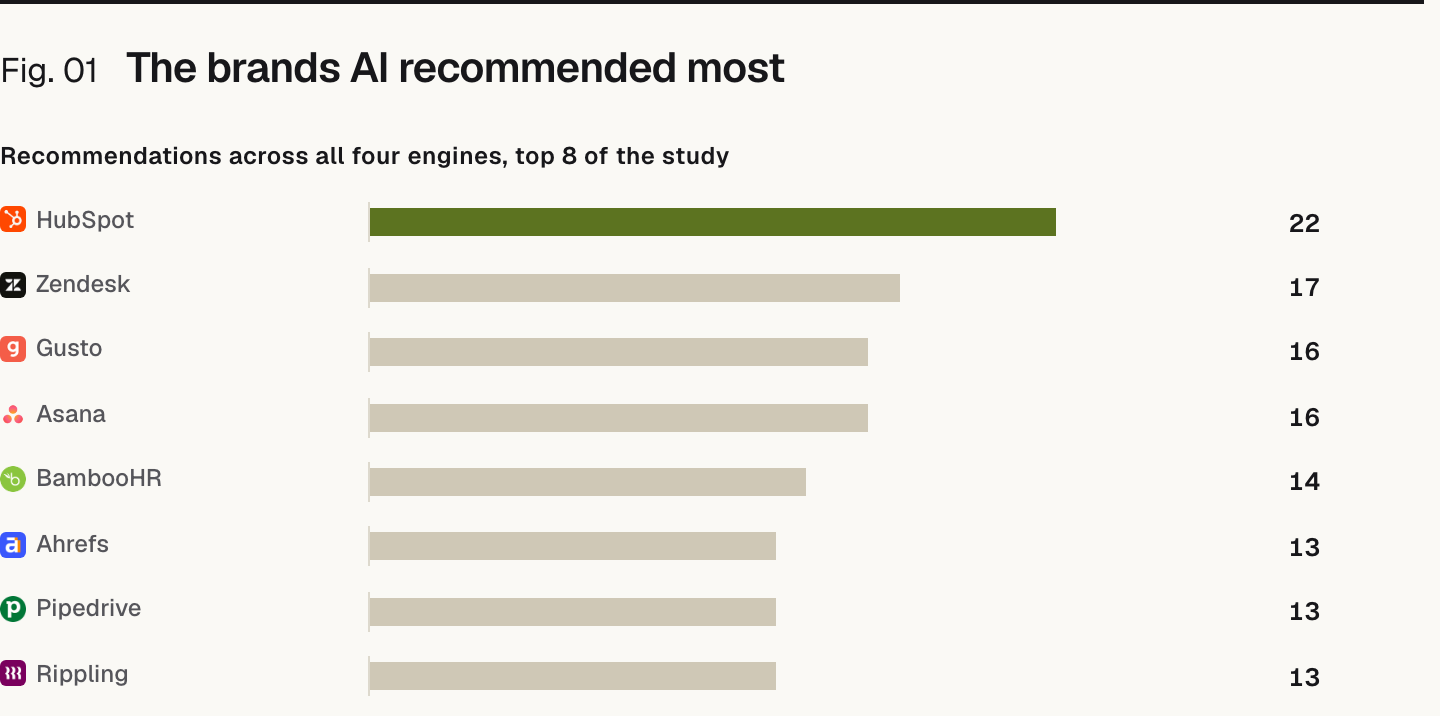
HubSpot leads with 22 recommendations. Notice what this list is not: it is not a ranking of product quality, funding, or size. It is a ranking of how much of the web writes about each brand. Every teardown below shows one way to become that.
Teardown 1: Zapier’s 12-year-old page#
Zapier was the #3 most-cited source in our study (31 citations), so we pulled the raw HTML of its flagship format, the “best CRM software” roundup, and dissected it first-hand (checked 2026-07-14):

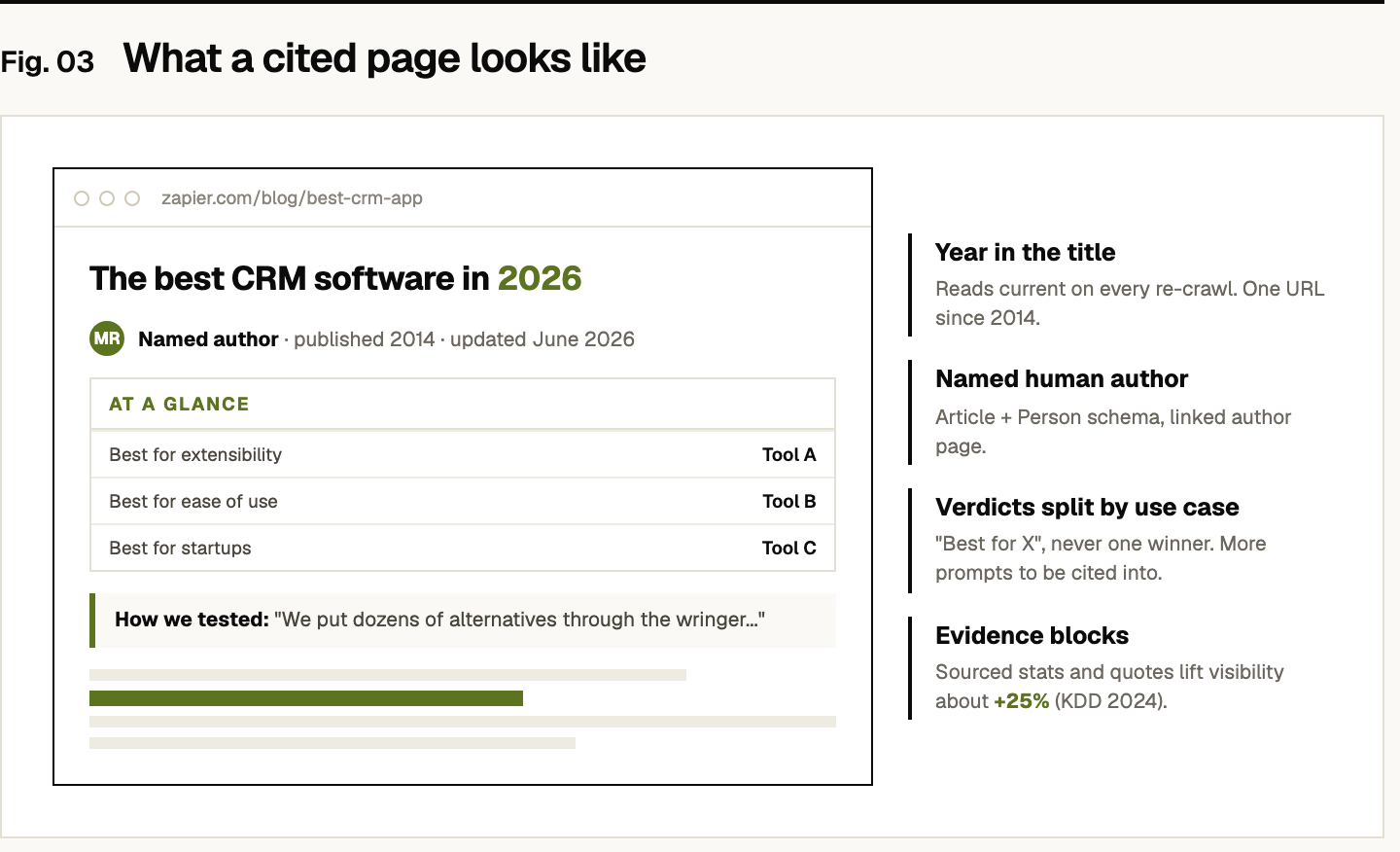
- The URL is from 2014. Structured data says published September 23, 2014, modified June 22, 2026, and an internal timestamp showed an update on July 9, 2026, days before we looked. Twelve years of authority compounding on one URL, refreshed continuously, instead of a new “best CRMs 2026” post every year.
- The title carries the year (“The best CRM software in 2026”) so every re-crawl reads current.
- A named human author (with a linked author page) sits in Article plus Person plus BreadcrumbList schema.
- Eleven segmented verdicts, every one framed “Best CRM for [extensibility, versatility, ease of use…],” never a single winner. Segmented verdicts answer more question variants, which means more prompts to be cited into.
- Explicit testing language (“We put dozens of Salesforce alternatives through the wringer”) plus an extractable “at a glance” summary near the top, a comparison table, and ~8,400 words structured into scannable blocks.
What happened: Zapier was one of only five domains cited by all four engines in our study, where 75% of domains got one engine only. What to do: stop rewriting; start refreshing. One page per money question, verdicts split by use case, a visible date, a named author. Source: our study plus first-hand HTML inspection, 2026-07-14.
Teardown 2: Reddit, where format beats popularity#
Reddit was the single most-cited source in our study (43 citations), and Semrush‘s much larger study (230,000 prompts, 100M+ citations, November 2025) found it the most-cited domain overall. The mechanism is the useful part:


- Q&A threads account for more than half of Reddit’s AI citations. A real question followed by direct answers is the exact shape of the query the engine is answering.
- Engagement is irrelevant: 80% of cited posts had fewer than 20 upvotes, and 70% had fewer than 20 comments.
- The engines paraphrase rather than quote (mean semantic similarity around 0.53), so the substance travels even when the words do not.
What happened: the least polished writing on the internet out-cites every brand marketing site on earth. What to do, twice: first, take part where the questions are asked (Play 23); second, structure your own pages the same way: a clear question, a direct answer, detail after. That is why every chapter in this playbook opens with an answer block. Source: Semrush Reddit study, 2025-11-10, checked 2026-07-14.
Teardown 3: G2, where reviews become citations#
G2 earned 19 citations in our study and was cited by all four engines. The reason is simple: verified reviews from many users are the closest thing the web has to neutral proof, and models treat them that way. A G2 category page is a structured ranking with pros, cons, and ratings: everything an engine wants when a buyer asks “which of these is actually good?” What to do: treat your review profiles as pages AI reads, not badges. Complete them, pick the right category, and get reviews on them (Play 20). Source: our study, 2026-07-10.

Teardown 4: Vercel, the docs that became a signup channel#
The strongest publicly verified brand win in AEO belongs to Vercel. ChatGPT referrals grew from under 1% of Vercel’s new signups in September 2024 to 4.8% by March 2025 to 10% by April 2025, per CEO Guillermo Rauch’s own published numbers, who called it the company’s fastest-growing acquisition channel.

The reason is plain: Vercel’s documentation is the free, open, best-maintained answer to the exact tasks its buyers ask AI about (deploying a Next.js app, above all). When a model explains “how do I deploy this,” it draws on Vercel’s docs, and the recommendation comes with it. What to do: treat your docs and reference pages as marketing pages now. Keep them open (no email gate), keep them the best answer to your category’s tasks, and keep them current. Sources: Rauch, March 2025 and April 2025, corroborated on Sequoia’s Training Data podcast; self-reported first-party figures, checked 2026-07-14.
Two warnings before you copy the winners#
First: the signals can be faked, and readers eventually notice. HouseFresh, an independent product-testing site, documented how big-media pages carrying tested-by-experts signals (lab photos, expert bylines, methodology boxes) dominate “best [product]” results, sometimes without real independent testing behind them; their first-hand account names 16 companies crowding them out. These signals work, which is exactly why some sites fake them. Use them honestly or they will eventually be held against you. Source: HouseFresh, updated 2025-12-17, checked 2026-07-14 (first-party account, qualitative).

Second: the old SEO reflexes can backfire. A peer-reviewed study (Aggarwal et al., KDD 2024) tested on-page tactics across 10,000 queries:
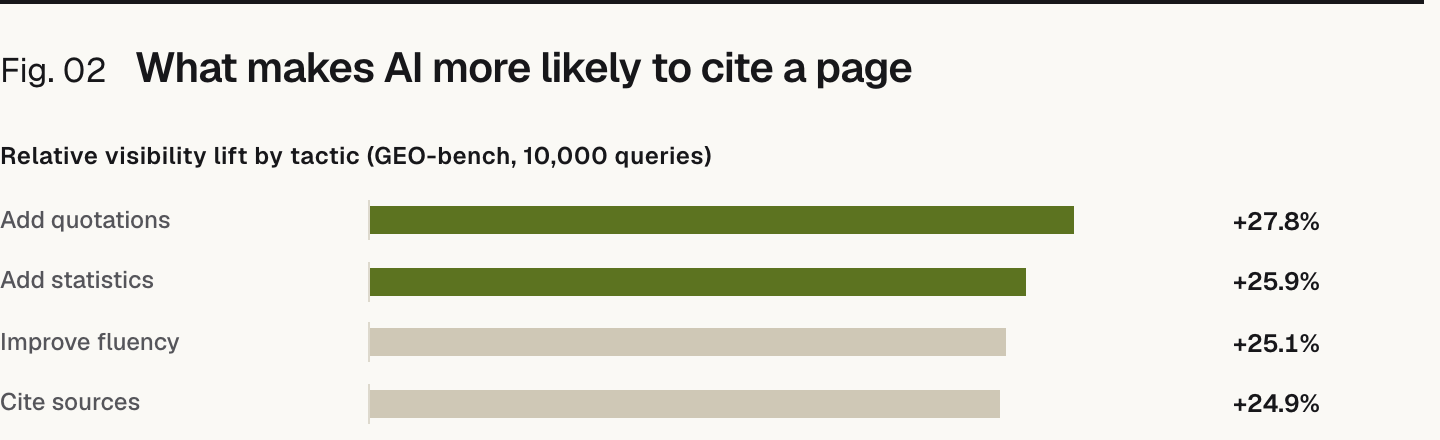
Quotations, statistics, and cited sources each lift visibility around 25%; keyword stuffing made pages less visible (19.5% baseline falling to 17.8%). The oldest SEO habit now actively hurts.
What all the winners share#
The plays#
Tear down the three pages that win your category
Replace guesswork with a checklist taken from whatever already wins your category's citations.
The winners are not hiding: your gap list (Play 09) names the exact pages AI cites instead of you. Zapier's dissection above took under an hour with a browser and a schema validator, and it converts 'write better content' into a measurable checklist. (First-hand Zapier teardown + study, checked 2026-07-14)
Before you start: Play 09's gap list (or just ask the engines your money prompts and take the three most-cited pages).
- Pick the three pages most cited for your money prompts.
- For each, record: published and modified dates (view source or a schema validator), whether the title carries the current year, named author with an author page or not.
- Record the structure: at-a-glance block? comparison table? segmented 'best for' verdicts or one winner? explicit criteria or testing language?
- Run each URL through a structured-data validator and note the schema types (Article, Person, ItemList, FAQPage).
- Score all three against the four-trait figure above, and note the one trait they ALL share: that is your category's price of entry.
 Google Rich Results Test
 Done when: A three-row teardown table with checklist scores and the shared-trait note.
Verify it worked: Show the table to someone who knows your buyers and ask which page they would trust. If their answer and the citation data disagree, trust the citation data; the engines already voted.
Common failure mode: Tearing down pages you admire instead of pages that get cited. The input is the gap list, not your taste.
Build an honest comparison page
Create the one honest comparison page in your niche that engines can safely cite when buyers ask 'which one?'
On 'X vs Y' questions in our study, vendors' own sites fell to 18% of citations because models prefer neutral judges. The scarce asset in most categories is a genuinely fair comparison. Where none exists, an honest, clearly disclosed one from a vendor can fill the gap, and in vendor-led categories your own comparison pages already get cited. (Visibly AI Citation Study, checked 2026-07-10)
Before you start: Play 16's teardown table, and your category verdict from Play 08.
- Pick the head-to-head or shortlist question your buyers actually ask (from your money prompts).
- Define 4-6 explicit criteria and state how you judged each. This section is the credibility engine; write it first.
- Write verdicts split by use case ('best for [use case]'), and let competitors win the ones they genuinely win. A comparison page where you never lose is a pitch.
- Disclose your product plainly ('X is our product') wherever it appears.
- Ship the full checklist: named author, summary table near the top, comparison table, Article + FAQPage schema, year in the title, and a refresh date you commit to.
Done when: The page is live with criteria, disclosed verdicts, schema, and a named refresh cadence.
Verify it worked: Re-ask your 'X vs Y' money prompts monthly and watch whether the page enters the citations. Also watch whether competitors' names appear WITH yours: fair comparison pages get cited for the whole matchup.
Common failure mode: Posing as a neutral judge while hiding that you are a contestant. Models and readers both punish it; self-promotional roundups are being demoted, and one dishonest verdict ruins the page's credibility.
Add the evidence layer everywhere
Retrofit the measurably-cited ingredients (statistics, quotations, cited sources) onto the pages you want lifted.
Peer-reviewed GEO research measured relative visibility lifts of +27.8% from quotations, +25.9% from statistics, and +24.9% from cited sources, while keyword stuffing REDUCED visibility from 19.5% to 17.8%. It is the only on-page tactic set with published, replicated experimental backing. (Aggarwal et al., KDD 2024, checked 2026-07-14)
- Pick your 5 most important pages (money pages plus the comparison page).
- Add 2-3 specific, sourced statistics per page, each with a linked source and a checked date, placed next to the claim it supports.
- Add at least one direct quotation per page (a customer, a named expert, or a primary source).
- Delete keyword stuffing wherever you find it: repeated exact-match phrases, keyword-list paragraphs, stuffed headers.
- Bold the one-sentence citable claim in each section so it survives extraction alone.
Done when: All 5 pages carry sourced stats, a quotation, zero stuffing, and bolded citable claims.
Verify it worked: Re-run the money prompts that map to each page after the next crawl and compare citation appearance against your Play 32 scoreboard baseline.
Common failure mode: Adding statistics without sources. An unsourced number is not evidence, it is decoration, and it hands sharp readers a reason to distrust the page.
Where this failed for us#
We once published a “case study” that was a composite: assembled from real patterns we had observed, but not a single named customer’s actual story. It felt harmless, it read well, and it was exactly the kind of unverifiable proof this chapter teaches you to distrust. We withdrew it, redirected the page, and rebuilt our rules: no proof without a name and a source, which is why every claim in this chapter carries one, and why the “8,337% growth” genre of agency case studies appears here only as a warning. The uncomfortable corollary we found while researching this chapter: verified positive AEO case studies are genuinely scarce. Vercel is the strongest public one; almost everything else is either platform-structural or marketing. Scarcity of proof is information. Distrust anyone in this industry who has too much of it.
Your content plan (3-5 cited-format pieces)
Fill this in from the three plays. It becomes the content column of your 90-day plan. Saves locally as you type.
Everything you type saves in this browser and assembles into one document on the Your plan page, where you can copy or download it. Nothing is sent anywhere. A duplicatable Notion and Google Sheets version ships with the companion pack.
Where this goes next#
Your content plan pairs with the off-page target list: your comparison page earns citations directly while the off-page plays get you into other people’s winning pages. Then the measurement chapter tells you honestly whether any of it worked. Every number cited here is anchor-linked on the statistics page, free to copy with attribution.
- What kind of content gets cited most in AI search?
- Do G2 reviews affect AI recommendations?
- What is generative engine optimization?
Frequently asked questions
What does a page that gets cited by AI actually look like?
The winners share the same traits: an established URL kept fresh (Zapier's best-CRM page was published in September 2014 and last modified in June 2026), a named human author with an entity page, clear criteria or testing language, verdicts split by use case rather than one winner, a summary block near the top, and Article plus Person plus Breadcrumb structured data. It reads like a fair review, not a pitch.
Do I need to be a big brand to get cited by AI?
No, and the Reddit data is the proof: in Semrush's November 2025 study, 80% of Reddit posts cited by AI engines had fewer than 20 upvotes and 70% had fewer than 20 comments. The engines are lifting the format (a real question followed by a direct, specific answer), not the popularity. A small brand with genuinely structured evidence can out-cite a large one with a prettier press page.
Should I publish my own 'best tools in my category' list?
Only as a referee, never as a contestant in disguise. Self-promotional roundups are being demoted, and in our study vendor sites fell to 18% of citations on 'X vs Y' questions precisely because models prefer neutral referees. If you publish one: explicit criteria, honest verdicts that sometimes favor competitors, your own product disclosed, and a real update cadence. If you cannot do that honestly, earn placement in other people's lists instead.
What are real, verified examples of AEO working?
Verified positive cases are rarer than the marketing suggests, which is worth knowing in itself. The strongest public one is Vercel: ChatGPT referrals grew from under 1% of new signups in September 2024 to 10% by April 2025, per the CEO's own published numbers, built on open, well-maintained documentation. The structural winners (Reddit, Zapier, G2) are verified by citation studies including ours. Most agency case studies claiming thousands of percent growth name no customer and publish no source; treat those as advertising.