How AI Engines Choose Their Sources: What 188 Answers Show
ChatGPT answered 29 of 47 questions from memory. Only 5 of 713 domains were cited by all four engines. What 188 measured AI answers reveal about source choice.

Your engine-reality check: a per-engine table of whether ChatGPT, Perplexity, Gemini, and Claude answer about your category from memory or live search, and which engine your effort should favor. Plays 02 and 03.
The four AI engines choose sources in measurably different ways. Across 188 logged answers, ChatGPT skipped live search on 29 of 47 questions and answered from memory, the four engines shared only 5 of 713 cited domains, and Perplexity produced 65 of the 75 community citations. There is no single 'AI search' to win. Each engine is its own channel and needs its own plan.
- ChatGPT answered 29 of 47 buyer questions from memory, citing nothing, so a large share of ChatGPT answers cannot be reached by any on-page fix.
- The four engines shared only 5 of 713 cited domains, and about 75% of domains were cited by a single engine: a win on one engine says almost nothing about another.
- The engines read different-sized webs: ChatGPT cited 89 distinct domains, Claude 220, Perplexity 273, Gemini 367, on identical questions.
- Visibility and clicks are different things: with an AI summary present, only 8% of Google visits clicked a result (Pew), yet cited brands earn about 120% more clicks per impression than uncited ones (Seer).
There is no single “AI search.” We asked ChatGPT, Perplexity, Gemini, and Claude the same 47 buyer questions and logged all 188 answers. The four engines behaved like four different products: they search the web at different rates, read different websites, and trust different kinds of sources. Everything you do later (which sites to get mentioned on, which pages to fix, what to measure) depends on knowing how each one actually behaves.
This chapter shows you what we measured, then gives you two plays to run the same check on your own category.
Memory answers vs live-search answers#
Every AI answer is built one of two ways. Either the engine searches the web, reads real pages, and cites them (this is called grounding), or it answers from memory: what it learned in training, with no reading and usually no citations.
This happens constantly. ChatGPT answered 29 of its 47 questions from memory in our study, citing nothing at all.
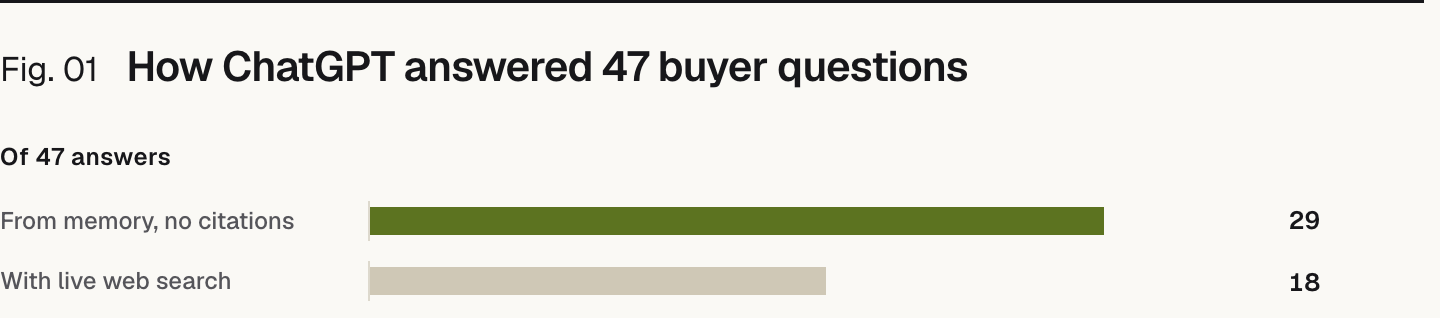
Here is why that matters, and it is the most important point in this chapter: no on-page fix can reach a memory answer. No schema, no llms.txt, no rewrite changes an answer the model wrote without reading anything. Memory answers only change when the model’s picture of your brand changes, and that comes from years of other people writing about you: the entity records, reviews, and coverage in the off-page chapter. Live-search answers are different: you can win those this quarter by getting onto the pages the engine reads.
The four engines do not use the same sources#
When the engines do search, they read very different sets of websites.
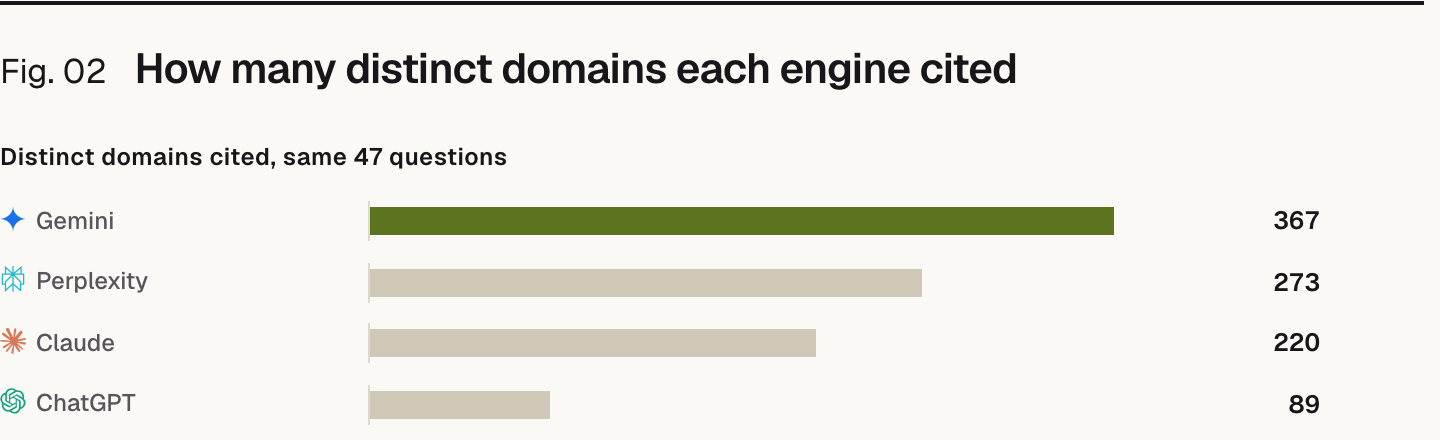
The overlap between those source sets is close to nothing: only 5 of the 713 domains cited were cited by all four engines (zapier.com, g2.com, forbes.com, thedigitalprojectmanager.com, getaleph.com), and about 75% of domains were cited by a single engine and no other. If you track one engine, you see about a quarter of the picture. Winning one engine tells you almost nothing about the next.
Each engine also has clear habits you can plan around:
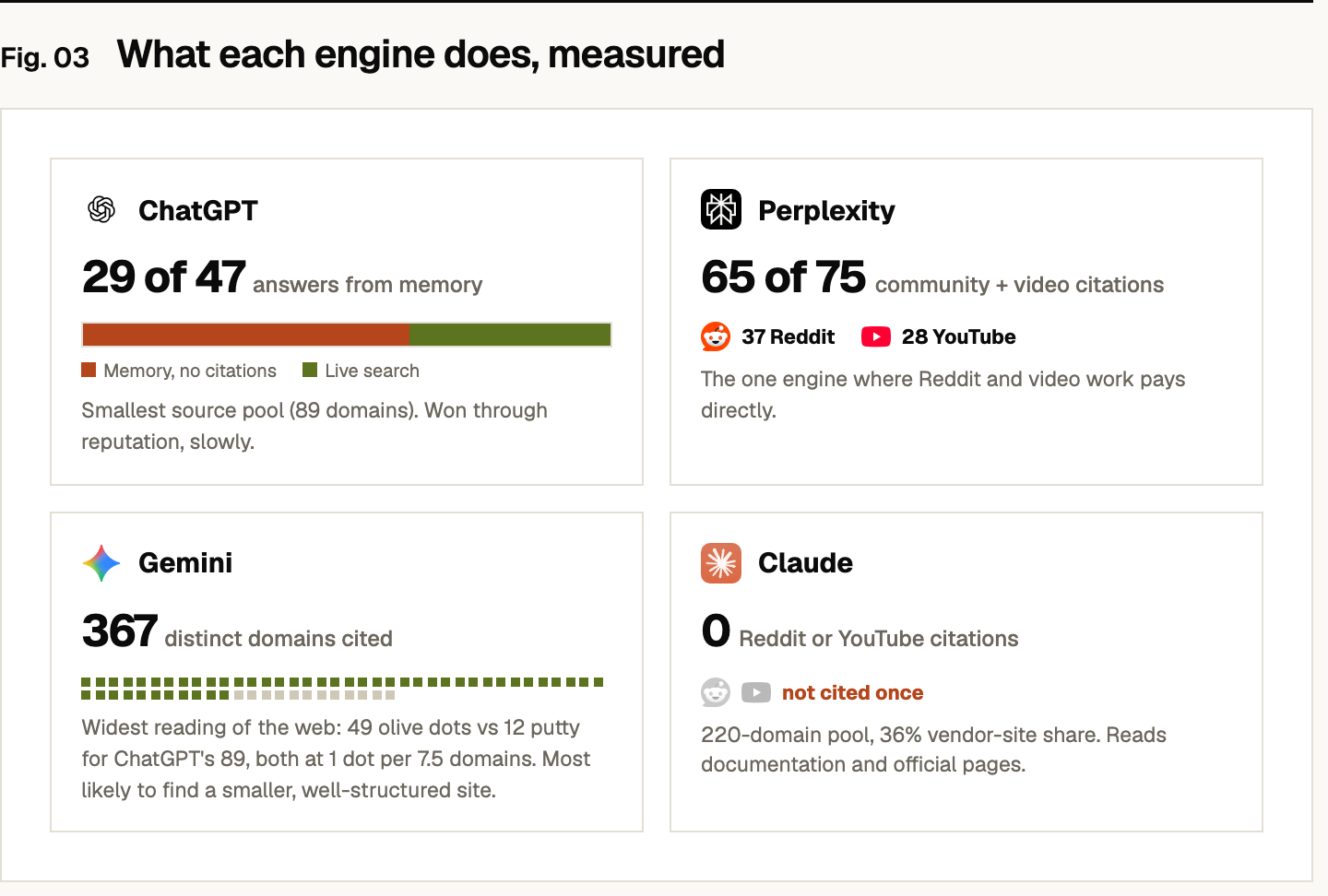
One more thing to respect: these habits change. Semrush documented ChatGPT citing Reddit in roughly 60% of responses in early August 2025 and about 10% by mid-September 2025, after OpenAI deliberately reduced how much it leaned on a few domains (Semrush, November 2025, checked 2026-07-14). A source an engine loves today can be turned down in a model update. So diversify, and re-run your checks; do not chase each swing.
What a citation is worth#
The numbers here are sobering and useful. Pew Research measured that when an AI summary appears on Google, only 8% of visits click a regular result (versus 15% without a summary), and just 1% click a link inside the summary itself. So clicks really are getting scarcer. But the value that remains goes to whoever is named IN the answer: Seer Interactive found brands cited in AI Overviews earn about 120% more organic clicks per impression than uncited brands (their data, a correlation), and Microsoft Clarity data reported by Digiday puts AI-referred signup conversion at roughly 1.66% against 0.15% from classic search. Fewer visitors, much warmer. The point for now is simple: the thing worth optimizing is the citation, not the session count. The measurement chapter turns that into your scoreboard.
The plays#
Two plays, about ninety minutes, and the mechanics above become a table about YOUR category instead of ours.
Run the memory-or-search test on your own category
Find out, per engine, whether answers about your category are grounded (winnable this quarter) or from memory (a longer game), and log which sources appear.
ChatGPT answered 29 of 47 questions from memory in our study while Perplexity grounded nearly everything. Until you know which route each engine takes for YOUR questions, you cannot tell whether on-page work, off-page work, or patience is the right spend. (Visibly AI Citation Study, checked 2026-07-10)
- Take 5 of your money prompts (Play 08 builds the full 10) plus one brand question: 'What is [your brand] ([your domain])?'.
- Ask each of ChatGPT, Perplexity, Gemini, and Claude all six questions. Save every answer verbatim.
- For each answer record: did it cite live sources, and if so which domains; if no citations, mark it a memory answer.
- For the brand question, record whether the engine describes the real company, guesses, or admits it does not know.
- Fill the four-row table: engine, memory or grounded (per question), sources seen, brand answer quality.
Done when: The four-row table is filled in with evidence, not impressions.
Verify it worked: Re-run the same six questions monthly. Engine behavior shifts with model updates; two consecutive agreeing runs make the table trustworthy.
Common failure mode: Testing with your brand name in the prompt and concluding you are visible. Buyers ask category questions ('best X for Y'), not your name; test what they actually type.
Pick your primary engine and set an engine budget
Stop spreading effort evenly across engines that do not behave evenly, and put your hours where your buyers and your category's mechanics overlap.
The engines share almost nothing: 5 of 713 domains overlapped across all four in our study, and about 75% of cited domains were cited by one engine only. Spreading your effort evenly across engines that behave this differently wastes most of it. (Visibly AI Citation Study, checked 2026-07-10)
Before you start: Play 02's engine-reality table, and ideally Play 08's category verdict.
- Score each engine on two axes: how grounded it is for your questions (from Play 02), and how likely your buyers are to use it (developer-heavy audiences lean ChatGPT and Claude; research-heavy buyers lean Perplexity; mainstream search intent lands on Google's AI surfaces).
- Name a primary engine (the one you will check weekly and optimize for first) and a secondary.
- Split your effort roughly 50/30/20 across primary, secondary, and the rest. Uneven on purpose.
- Match the work to the engine: community and video plays move Perplexity; entity and memory work moves ChatGPT; broad crawlable structure feeds Gemini; formal documentation feeds Claude.
- Re-score quarterly. Engines rebalance their source mixes, and your budget should follow the data, not the habit.
Done when: A written engine budget: primary, secondary, split, and the work each engine gets.
Verify it worked: At the quarterly re-score, check citation movement per engine against where you spent. If your primary engine did not move and a neglected one did, rebalance.
Common failure mode: Optimizing for the engine you personally use instead of the one your buyers use. The founder's favorite assistant is a sample size of one.
Where this failed for us#
Our first citation baseline was nearly worthless, and it is exactly the mistake this chapter warns about. On our Day-0 check, only 1 of our 7 tracked queries actually triggered live web search; the rest came back as memory answers with no citations. We were unknowingly measuring the model’s memory (where a young brand is invisible by default) and calling it citation tracking. We had to rephrase every prompt to force grounding before the scoreboard meant anything. If your prompts do not reliably trigger live search, you are not measuring AI search visibility, you are measuring training data. Check the grounded-versus-memory split before trusting any number, including ours.
Real examples#
ChatGPT cut Reddit citations from 60% to 10% in six weeks. What happened: Semrush documented ChatGPT citing Reddit in close to 60% of responses in early August 2025 and about 10% by mid-September 2025, after OpenAI changed its source mix; Medium and Wikipedia rose instead. Why it matters: which sources an engine cites is a choice made by the engine’s vendor, and it can change overnight. What to do: spread your presence across several sources and engines, and put a date on every share figure you rely on. Source: Semrush, 2025-11-10, checked 2026-07-14.
Most people do not click when an AI summary appears. What happened: Pew’s 900-participant browsing study measured 8% click-through with an AI summary present versus 15% without, and 1% clicks on the summary’s own links. Why it matters: the recommendation increasingly happens inside the answer, without a click. What to do: judge AI search by whether you are named in the answer, not by referral sessions alone. Source: Pew Research Center, 2025-07-22, checked 2026-07-14.
Your engine-reality check
Fill this in from Play 02's runs. It routes your engine budget and feeds the measurement chapter's scoreboard. Saves locally as you type.
Everything you type saves in this browser and assembles into one document on the Your plan page, where you can copy or download it. Nothing is sent anywhere. A duplicatable Notion and Google Sheets version ships with the companion pack.
Where this goes next#
The engine-reality check is the second input to your 90-day plan. Pair it with your category verdict and the two artifacts decide almost everything: which surfaces to earn (off-page), and how to keep score honestly (measurement). If you want the whole test run for you, the free AI visibility audit executes it across engines in about 15 minutes.
- What is grounding in AI search?
- What is retrieval-augmented generation (RAG)?
- Do ChatGPT and Perplexity use the same sources?
- What is llm visibility?
Frequently asked questions
How does ChatGPT choose which sources to cite?
Often it does not choose sources at all: in our 188-answer study, ChatGPT answered 29 of 47 buyer questions purely from memory, citing nothing. When it does search, it draws from the smallest source pool of the four engines we measured (89 distinct domains against Gemini's 367) and cites vendors' own sites least (23% of its citations). Practically, ChatGPT visibility is built in two places: the model's memory, earned through years of consistent third-party documentation, and a comparatively small set of trusted live sources.
Do ChatGPT, Perplexity, Gemini, and Claude cite the same sources?
Almost never. Of 713 distinct domains cited across the four engines in our study, only five were cited by all four (zapier.com, g2.com, forbes.com, thedigitalprojectmanager.com, and getaleph.com), and about 75% of domains were cited by one engine only. The engines also pull from different-sized pools on identical questions. Winning a citation on one engine is close to no guarantee of winning it on another, which is why per-engine measurement matters.
What do grounding and RAG mean in AI search?
Grounding (often implemented as retrieval-augmented generation, or RAG) is when an AI engine runs a live search, reads real pages, and builds its answer from them, citing its sources. The alternative is a memory answer, generated purely from training data with no live reading and usually no citations. The split matters commercially: grounded answers can be influenced this quarter by earning citable surfaces, while memory answers only change as the model's training data does.
Does being cited in AI answers actually drive clicks?
Fewer clicks than classic search, but better ones. Pew measured that when an AI summary appears, only 8% of Google visits click a traditional result versus 15% without, and only 1% click links inside the summary. But Seer Interactive found brands cited in AI Overviews earn about 120% more organic clicks per impression than uncited brands, and Microsoft Clarity data reported by Digiday puts AI-referred visitor signup conversion around 1.66% versus 0.15% from search. Fewer clicks, roughly eleven times the intent.