Measure AI Search: Citation Share, Referrals, and ROI
AI summaries roughly halve organic clicks, so sessions mislead. Four plays to build an honest AI search scoreboard: citation share, referrals, a weekly routine.

Your scorecard live: 10 money prompts tracked per engine every week, AI referrals visible in your analytics, and a reporting format that survives scrutiny. Plays 32 to 35.
You cannot manage AI search with session counts. With an AI summary present, only 8% of visits click a result (Pew), yet cited brands earn about 120% more clicks per impression (Seer) and AI-referred visitors convert at roughly eleven times search visitors. The metric that works is citation share: the fraction of your money prompts that name you, per engine, weekly.
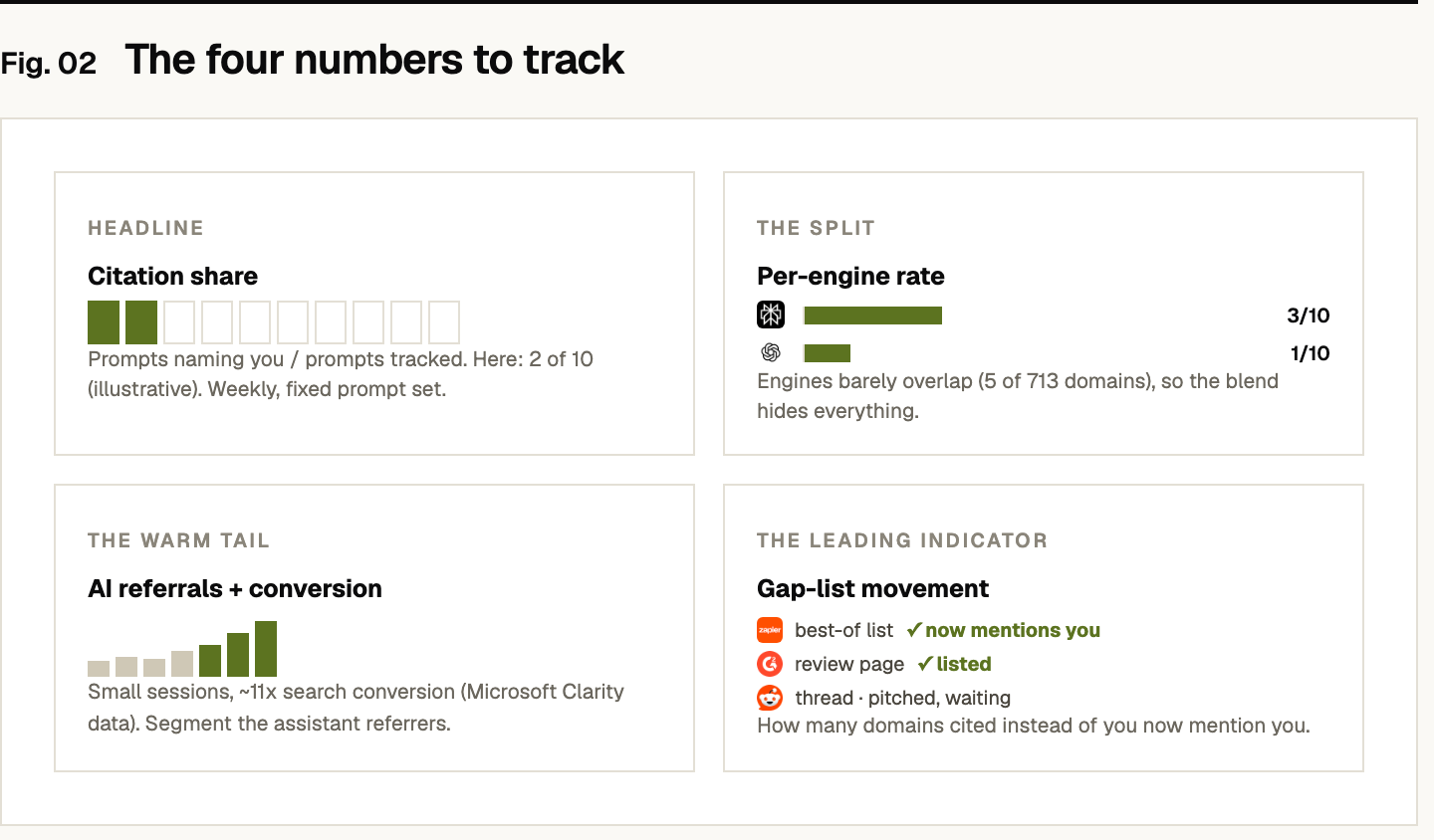
- Citation share (prompts naming you / prompts tracked, per engine) is the headline metric of AI search, because the click is no longer where the influence happens.
- With an AI summary present, 8% of Google visits click a traditional result versus 15% without, and only 1% click links inside the summary (Pew, July 2025).
- Being cited still pays: brands cited in AI Overviews earned about 120% more organic clicks per impression than uncited brands (Seer Interactive, 2026).
- AI referral traffic is small but converts hard: roughly 1.66% to signup versus 0.15% from classic search (Microsoft Clarity data via Digiday, December 2025).
- Chegg's collapse (organic traffic to −49% YoY) is the cost of watching blended sessions instead of the non-brand organic cliff forming underneath.
If you measure AI search with the metrics you already have, you will conclude it barely exists, right up until it has quietly decided who your buyers shortlist. Referral sessions from assistants are a rounding error in most analytics accounts. Meanwhile the recommendation happens inside the answer, unclicked, unattributed, and entirely measurable if you measure the right thing.
This chapter builds the scoreboard: what to track, the weekly routine, and the honest reporting rules, with a worked example so you can see a full week of it end to end.
Why your analytics miss AI search#
Three measured facts explain it:
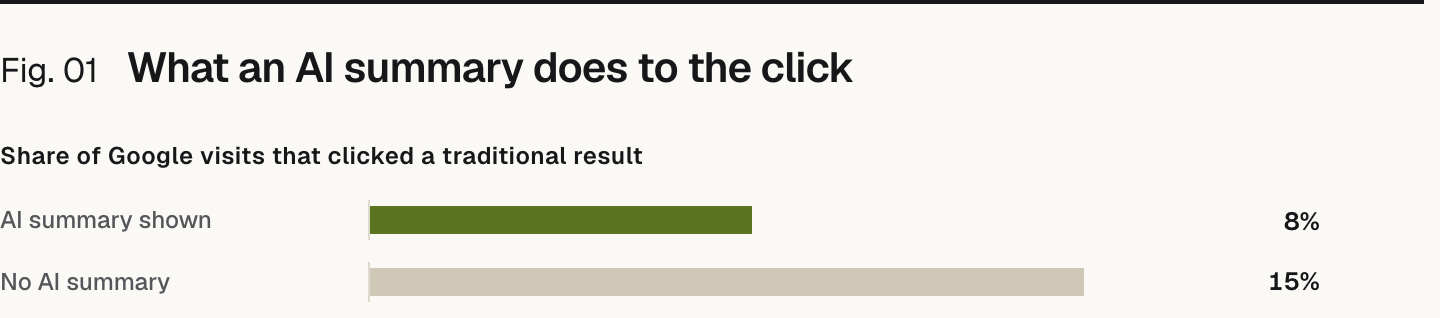
First, the click is evaporating where summaries appear: 8% versus 15%, and just 1% of users click the summary’s own citation links (Pew, July 2025). Second, the remaining value concentrates on whoever is cited: Seer Interactive’s 53-brand, 5.47M-query dataset found cited brands earn about 120% more organic clicks per impression than uncited ones (their caveat and ours: correlation, not proven causation). Third, what does click converts absurdly well: Microsoft Clarity data across 1,200+ sites, reported by Digiday, put AI-referred signup conversion at roughly 1.66% versus 0.15% from classic search, about eleven times, on traffic that is still only around 1% of the web.
Put together: small referral numbers, large hidden influence, high-intent tail. A dashboard built on sessions sees only the first fact and files AI search under “ignore.”
And the cost of measuring nothing has a name: Chegg. Its organic traffic slid from −8% year over year in mid-2024 to −49% by January 2025, revenue fell 24%, and the company’s own antitrust filing blames answers being consumed in-SERP. The cliff was visible early, but only in non-brand organic tracked separately, not in blended sessions. Source: MediaPost and Chegg’s public filings, checked 2026-07-14.
The four numbers to track#
One week of the scoreboard, worked through#
Here is week one for a made-up expense-tool brand, Acme (an illustrative example). Acme fixes 10 money prompts and runs them through ChatGPT and Perplexity. Results: cited in 2, mentioned without a source in 1, absent from 7. Citation share: 2 of 10 blended, 3 of 10 on Perplexity, 1 of 10 on ChatGPT. The same hour of logging produces a 14-domain gap list, and 6 of those domains are best-of lists whose authors answer email. That is the whole system: one number to move, per engine, and a to-do list as the byproduct. Two practical notes: prompts that return memory answers measure nothing (the engine chapter covers the fix), and single-run swings are noise, the trend is the signal.
The plays#
Build your citation scoreboard
Stand up the weekly measurement that tells you whether any of this playbook is working: your share of the answers that matter.
The influence happens inside answers you cannot see in analytics: only 1% of users click an AI summary's links (Pew), yet cited brands earn about 120% more clicks per impression than uncited ones (Seer). Presence in the answer is measurable only by asking the questions and logging the answers. (Pew Research, July 2025, checked 2026-07-14)
Before you start: Your 10 money prompts (Play 08) and your engine priorities (Play 03).
- Fix the prompt set: your 10 money prompts, unchanged week to week. Stability is what makes the trend readable.
- Every week, same day, run all 10 through your primary and secondary engines. Confirm answers are grounded (citations present); rephrase any prompt that keeps returning memory answers.
- Log per prompt per engine: cited (linked or named as a source), mentioned (named, not sourced), or absent. Save the verbatim answers.
- Compute citation share per engine and blended. Log every domain cited instead of you into the gap list.
- Chart the weekly series. Judge two-to-three-week trends, never single runs.
Done when: Three consecutive weekly runs are logged and the share chart exists.
Verify it worked: The scoreboard verifies itself: re-runs are the verification. Sanity-check by having a colleague run the same prompts; scores should agree within a point or two.
Common failure mode: Changing the prompt set every week to chase better numbers. A moving benchmark measures nothing; fix the prompts and let the score be ugly until it is not.
Segment AI referrals in your analytics
Make the small-but-hot AI referral channel visible, priced, and attributable in the analytics you already run.
AI-referred visitors converted to signup at roughly 1.66% versus 0.15% from classic search in Microsoft Clarity data across 1,200+ sites (reported by Digiday, December 2025). A channel converting at eleven times search deserves its own row, even while it is 1% of traffic. (Digiday, Dec 2025 (Similarweb/MS Clarity data), checked 2026-07-14)
- In your analytics, build a session-source segment matching the assistant referrers: chatgpt.com, perplexity.ai, gemini.google.com, copilot.microsoft.com, claude.ai.
- Mark your real conversions (signup, audit, demo) as key events BEFORE reading the segment; unmarked events report zero conversions no matter what happens.
- Build one exploration: AI-referred sessions, conversion rate, and top landing pages, alongside the same cuts for organic search.
- Read it monthly next to the citation scoreboard, and expect undercounting: referrers get stripped, and memory answers send no referrer at all.
- Price the channel: conversions from AI referrals against the hours you spend on the plays.
 Google Analytics
 Done when: The segment exists, key events are marked, and the exploration renders real rows.
Verify it worked: Click your own site from an assistant answer and confirm the session lands in the segment.
Common failure mode: Treating referral counts as the whole channel. Referrals are the visible tail; the citation scoreboard measures the body. Report them together or the channel looks ignorable.
Set the routine: weekly check, monthly report, quarterly review
Turn measurement from an occasional panic into a routine cheap enough to survive a busy quarter.
AI answers change from run to run, and engines change their source mixes: ChatGPT's Reddit citation rate went from roughly 60% to 10% in about six weeks in late 2025 (Semrush). Only a fixed routine separates real movement from noise, and only a quarterly review catches your category's pattern shifting under you. (Semrush, Nov 2025, checked 2026-07-14)
Before you start: Plays 32 and 33 running.
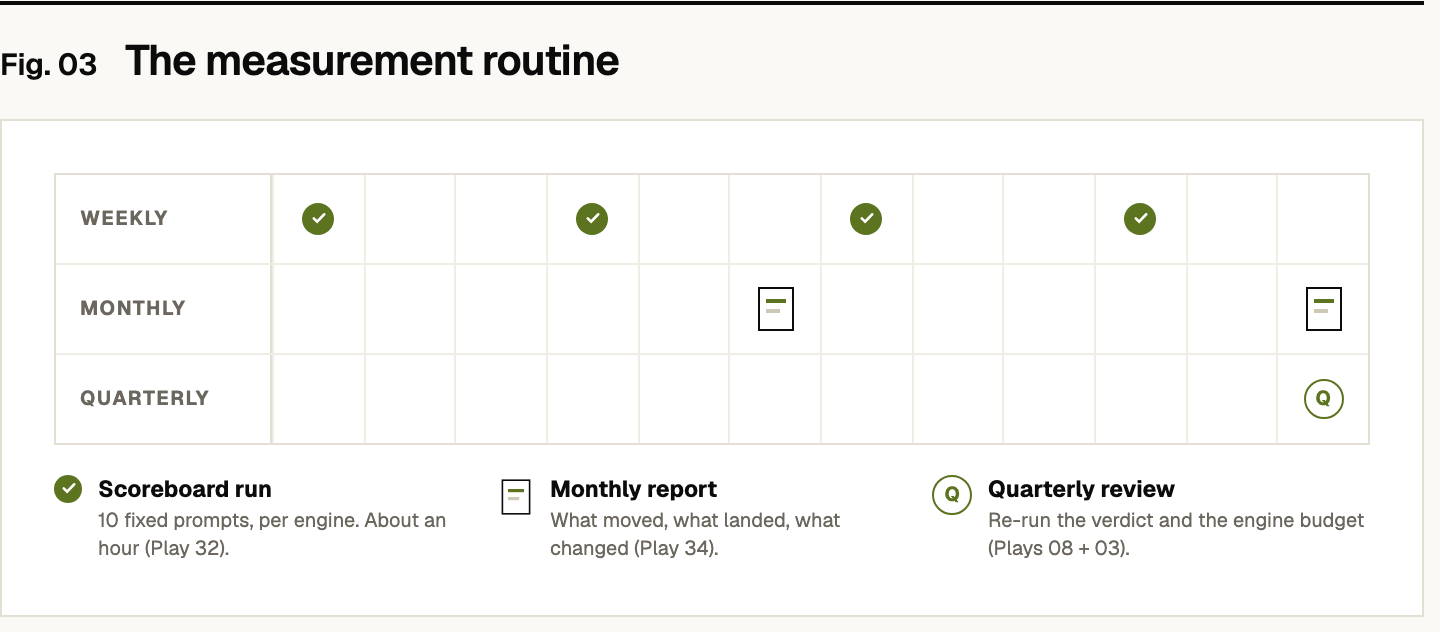
- Weekly (about an hour): run the Play 32 scoreboard, diff the gap list, log any placements that went live.
- Monthly (about an hour): write a short report. Three sections: what moved on the scoreboard, what landed (placements, reviews, links), what changed in the engines. Put a date on everything.
- Quarterly: re-run the category verdict (Play 08) and the engine budget (Play 03); refresh your comparison and money pages so their dates stay honest.
- Put all three on the calendar now, with a named owner. Routines without an owner die in week three.
Done when: Three calendar entries exist with owners, and the first monthly report is written.
Verify it worked: In month two, check whether month one's 'next actions' happened. A routine that produces reports but no actions is theater.
Common failure mode: Measuring weekly but never writing the monthly report. Raw logs rot; the report is what management, clients, and future-you actually read.
Report it honestly
Publish numbers that survive scrutiny, because the first cherry-picked screenshot costs you the credibility every later report needs.
AI answers vary by engine, session, and day, which makes cherry-picking trivially easy and trivially exposable: anyone can re-run your prompt and get a different answer. The only reporting that compounds trust is trend reporting with its variance labeled. (Our methodology and its caveats, checked 2026-07-14)
- Report trends over windows (2-3 weeks minimum), never single-run scores.
- Label variance explicitly: which engine, what date range, how many runs, what changed in the prompt set (ideally nothing).
- Show cited-versus-not cuts and per-engine splits, not just a blended score that flatters.
- Around every placement or launch, publish the before/after window with dates, and attribute honestly: correlation, unless you can show more.
- Publish the misses alongside the wins. If your share is zero, say zero; the credibility you bank is what makes the eventual wins believable.
Done when: Your monthly delta carries dates, windows, variance notes, and at least one number that does not flatter you.
Verify it worked: Hand a report to a skeptic with the instruction 'try to catch it exaggerating.' If they can, tighten it before someone less friendly does.
Common failure mode: The screenshot of the one good answer. It is the industry's favorite artifact and its least reproducible; one client re-running the prompt kills the relationship.
Where this failed for us#
For weeks, our own conversion tracking was decorative. The CTA events on this site fired correctly (13 audit clicks logged in one 28-day window), but nobody had marked them as key events in GA4, so every report read zero conversions while real conversions happened. A measurement pipeline you have not wired end to end is indistinguishable from no measurement; Play 33’s step 2 exists because we skipped it. Same lesson, smaller stakes, as the baseline we botched with memory answers: the scoreboard only counts if you have verified what it is actually counting.
Real examples#
Chegg What happened: non-brand organic traffic slid from −8% year over year (mid-2024) to −49% (January 2025) as Google answered its questions in the results page; revenue fell 24%, subscribers 13%, and Chegg sued. Why it matters: the collapse was visible months early in exactly one place, non-brand organic tracked on its own. What to do: split brand from non-brand traffic today and watch the trend. Source: MediaPost + public filings, checked 2026-07-14.

Vercel What happened: the opposite story. By measuring signups by referrer, Vercel saw ChatGPT go from under 1% to 10% of new signups in eight months, named it their fastest-growing channel, and invested in it. Why it matters: the channel looked tiny in raw traffic while it became their best converter. What to do: Play 33, then judge the channel on conversions, not sessions. Source: Rauch, April 2025, first-party figures, checked 2026-07-14.

Your scorecard + routine
Fill this in as the plays go live. It is the accountability column of your 90-day plan. Saves locally as you type.
Everything you type saves in this browser and assembles into one document on the Your plan page, where you can copy or download it. Nothing is sent anywhere. A duplicatable Notion and Google Sheets version ships with the companion pack.
Where this goes next#
The scoreboard is the last piece before you put it all together: with your category verdict, engine budget, target list, content plan, and this scorecard, the 90-day plan chapter (in progress) turns them into a calendar. Until it ships, the order is simple: baseline this week, off-page and content plays next, first delta in 30 days. If you want the scoreboard run for you across engines and competitors, with the verbatim answers kept as receipts, that is the free audit and the Visibly platform (our product, disclosed). Either way: measure honestly, publish the zeros, and let the trend do the talking.
- What is share of voice in AI search?
- What is llm visibility?
- How often do AI answers change?
Frequently asked questions
How do I track AI search visibility?
Track citation share: write the 10 questions your buyers actually ask an assistant, run them weekly through at least two engines (one grounded, like Perplexity), and record per engine whether your brand is cited, merely mentioned, or absent. Your share is prompts-naming-you divided by prompts tracked. By hand it takes about an hour a week; the verbatim answers you save become your evidence trail, and the domains cited instead of you become your outreach gap list.
Do AI citations drive actual traffic and revenue?
Less traffic, better traffic, and measurable influence beyond the click. Pew measured that only 1% of users click links inside an AI summary, so raw referrals stay small (about 1% of web traffic in late 2025 aggregates). But Seer Interactive found cited brands earn about 120% more organic clicks per impression than uncited ones, and Microsoft Clarity data reported by Digiday puts AI-referred signup conversion near 1.66% versus 0.15% for classic search. Measure citations for influence, referrals for the warm tail, and conversions to price the channel.
What tools do I need to track AI citations?
You can start with nothing but the engines and a spreadsheet: the weekly by-hand scoreboard in this chapter costs about an hour. Purpose-built tools (Visibly included, disclosed: it is our product) automate the same loop across engines and competitors and keep the verbatim answers as receipts. Whatever you use, insist on seeing the actual answers behind any score; a visibility number you cannot audit is a vanity metric.
How often should I measure AI search visibility?
Weekly for the citation scoreboard, monthly for the summary report, quarterly for re-running your category verdict and engine budget. AI answers are non-deterministic and engines rebalance their source mixes (ChatGPT's Reddit citation rate moved from roughly 60% to 10% in six weeks in late 2025), so read two-to-three-week trends, never single runs, and date-stamp every number you publish.