Off-Page AEO: Earn the Citations That Actually Win
40% of AI citations go to third-party listicles, not brand sites. Eight plays to earn the reviews, roundups, and Reddit presence that get you cited by ChatGPT.

Your 20-surface target list (the exact reviews, directories, roundups, subreddits, and press that AI cites in your category) and your first 5 pitches drafted. Plays 19 to 26.
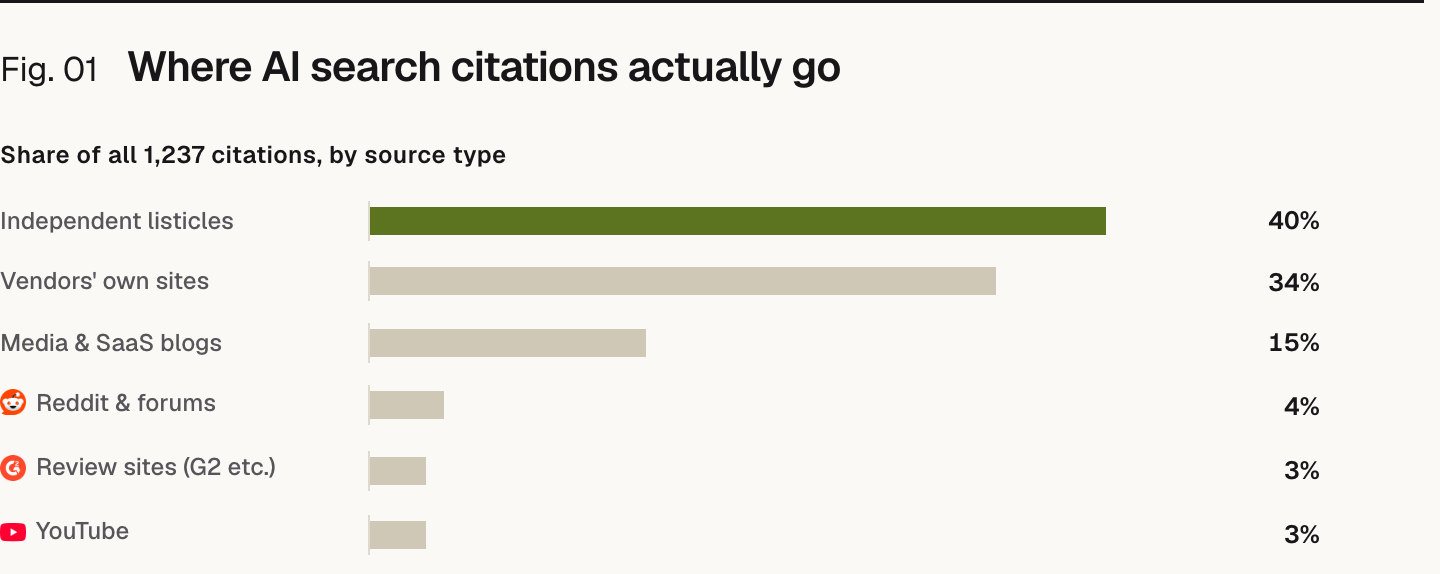
The biggest source of AI citations is not your website. In our study of 1,237 citations across four engines, 40% went to independent listicles and only 34% to vendors' own sites. Off-page AEO is earning presence on the places AI already trusts: entity records, reviews, directories, communities, best-of lists, and press. Eight plays build it, in order of impact.
- 40% of AI search citations go to independent third-party listicles, ahead of vendors' own sites at 34%, so getting into other people's lists beats optimizing another page of your own.
- ChatGPT answered 29 of 47 buyer questions from memory with no live search, which makes entity records and long-term brand documentation part of off-page work.
- reddit.com was the most-cited single source in the study (43 citations) and g2.com was #4 (19), and both are places you earn your way into, never buy.
- Every play here ends with a check you can repeat: re-ask the engines your money prompts and watch whether the place you earned shows up.
The biggest source of AI citations is not your website, it is the people writing about your category. When we logged all 1,237 citations the four major engines produced across 47 buyer questions, 40% pointed at independent third-party listicles and only 34% at the vendors’ own sites. The rest went to media, Reddit, review sites, and YouTube. Every one of those surfaces is off your domain, and every one of them can be earned.
This is the most important chapter in the playbook. It gives you eight plays, in order of impact, that get your brand onto the places AI already trusts: review sites, directories, best-of lists, Reddit, press. (We call these places “surfaces” throughout; a surface is simply anywhere AI reads and cites.) You will finish with a 20-surface target list for your own brand and your first five pitches drafted.
One honest note before the plays: this is the slowest chapter in the book and the one most worth doing. On-page fixes ship in an afternoon. Earning a place in someone else’s list takes weeks. But a placement, once earned, keeps answering for you.
Why off-page beats on-page right now#
Ask the engines who to buy from and they mostly do not read the brands. They read the writing about the brands.
The external research points the same direction. Search Engine Land’s 2026 review found Reddit, YouTube, and LinkedIn the most-cited sources across AI engines. Search Influence’s analysis found review-site profiles roughly triple the likelihood of a ChatGPT citation. A network-level study reported by openPR put numbered listicles near 63% of AI citations. And one 2026 industry analysis estimates the median AI-citation lift from earned media at around +239%, the largest of any tactic it measured. Those are third-party numbers, so treat the exact figures as directional. The direction, though, is unanimous.
There is a second, quieter reason off-page wins: memory. ChatGPT skipped live web search on 29 of its 47 answers in our study and answered from what it already knows. No on-page fix reaches a model that is not reading pages. What reaches it is years of other people writing about you: the entity records, reviews, and coverage the model learned from.
The five kinds of places that earn citations#
Every play in this chapter gets you onto one of five kinds of places. Together they cover about two-thirds of all citations we measured.
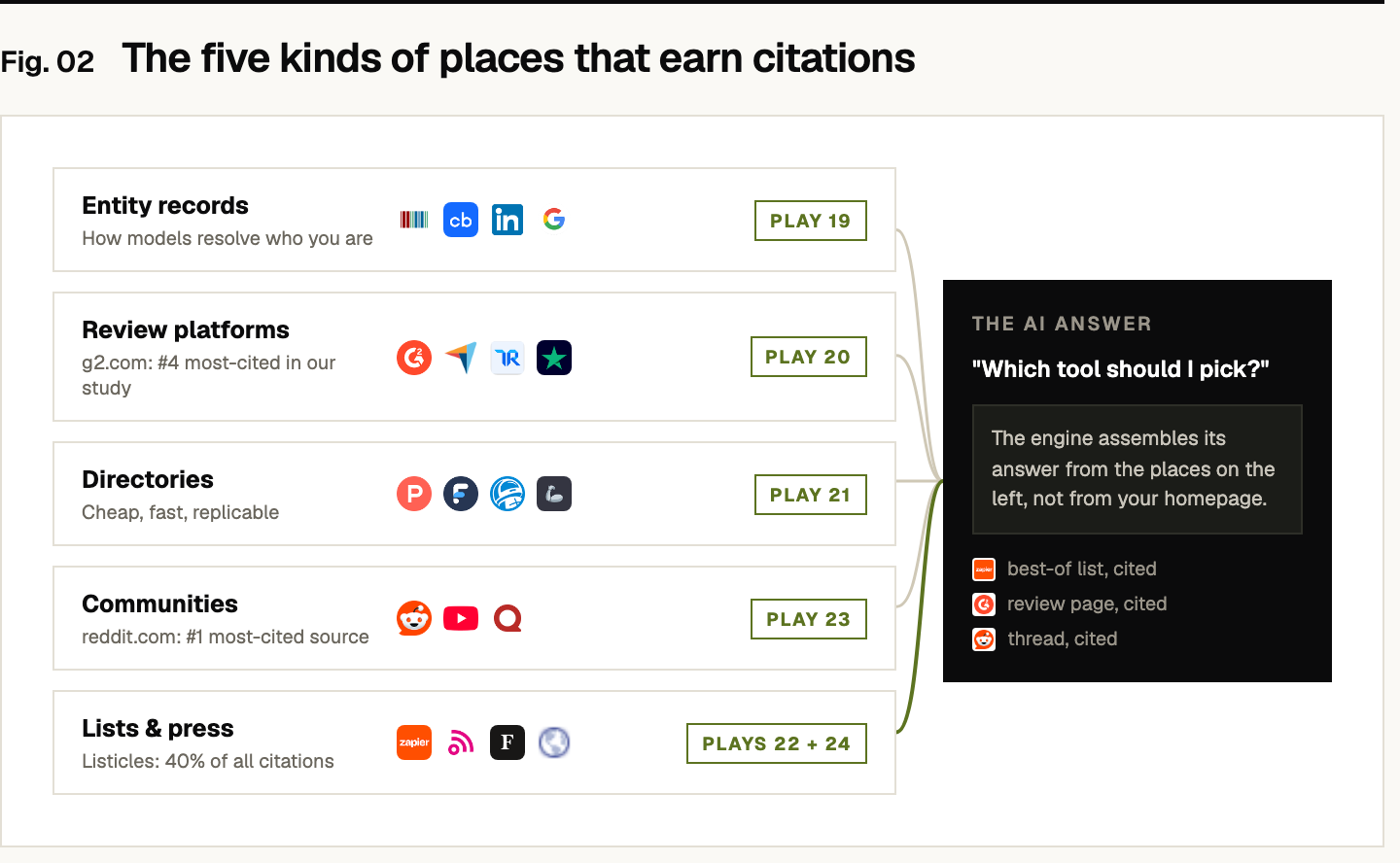
Who actually sits at the top of those places today? Straight from the study’s scoreboard:
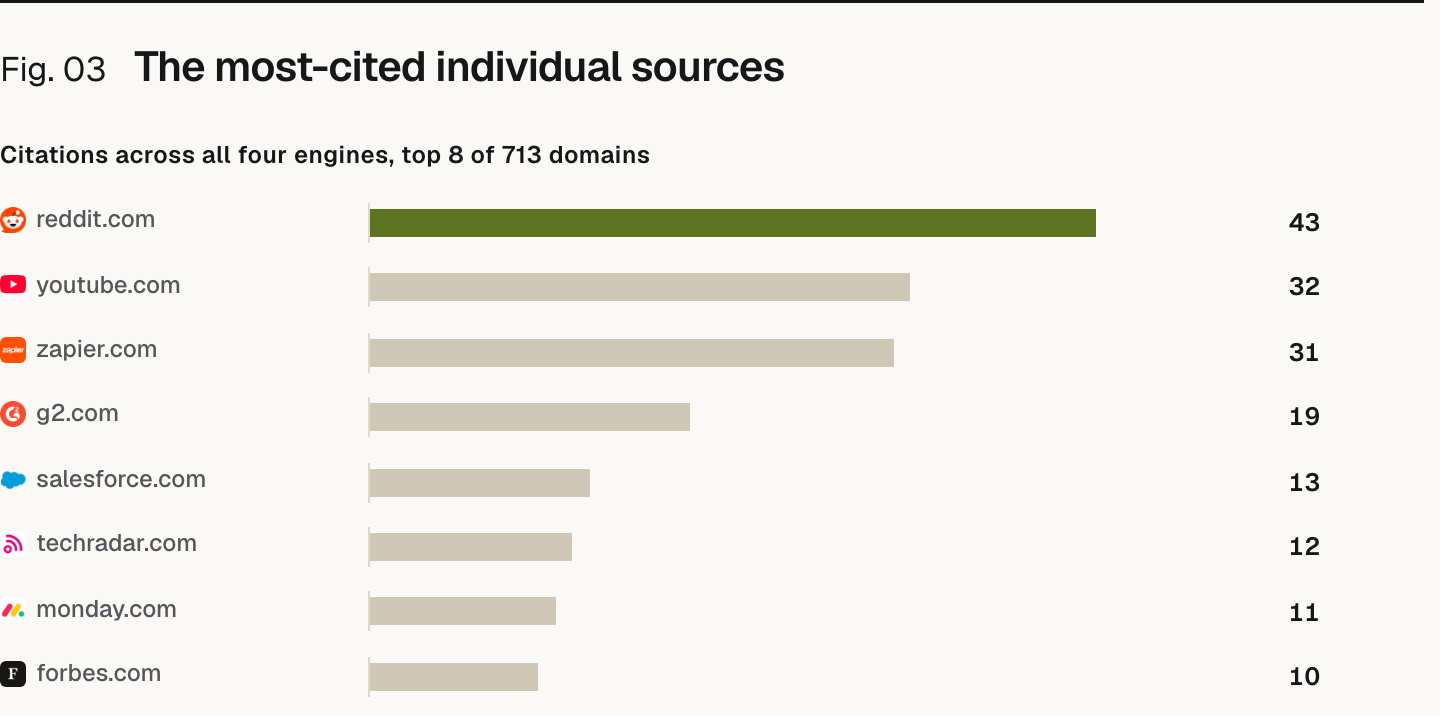
Reddit, YouTube, Zapier, G2. Not one of them is a brand marketing site. Those are the kinds of places this chapter helps you get into.
The plays#
Eight plays, ordered by impact for a brand starting from little or nothing. Every effort and time-to-impact figure is an estimate, not a measurement. AI answers change from run to run, so each play ends with a check you can repeat.
Claim your entity across Wikidata, Crunchbase, and LinkedIn
Make your brand resolvable, so models answering from memory describe the real company instead of guessing.
ChatGPT answered 29 of 47 buyer questions from memory with no live search in our study, so what the model already knows about you decides those answers. Entity records are the most direct write path into that knowledge. (Visibly AI Citation Study, checked 2026-07-10)
- Write one canonical boilerplate: legal name, one-sentence description, category, founding year, founders, HQ, and domain. Every profile uses exactly this.
- Complete your Crunchbase profile with the boilerplate, logo, and links.
- Create a Wikidata item: instance of (your company type), official website, industry, founders. The notability bar is low; the resolution value is high.
- Rewrite your LinkedIn company page About section with the same boilerplate.
- Claim your Google Business Profile, even without a storefront.
- Publish the same description on your site's about page and in your llms.txt, so on-site and off-site records agree.
 Wikidata: new item
  Crunchbase
  LinkedIn company page
 Done when: All profiles live with identical boilerplate, and your about page matches them.
Verify it worked: Ask ChatGPT and Perplexity 'What is [your brand] ([your domain])?' and check the answer describes the real company. Re-ask monthly.
Common failure mode: Drafting the profiles and never publishing them. We did exactly this for three weeks, and the model kept hallucinating our company in the meantime.
Get your first 10 reviews on G2 and Capterra
Put your brand on the review surfaces AI engines read and cite when they compare tools.
g2.com was the #4 most-cited source in our study (19 citations) and one of only 5 domains cited by all four engines. Third-party analysis by Search Influence found review-site profiles roughly triple the likelihood of a ChatGPT citation. (Search Influence, checked 2026-07-10)
- Create your G2 listing: right category, complete profile, real screenshots, honest feature checklist.
- Repeat on Capterra (and TrustRadius if you sell mid-market or up).
- List your 20 happiest users or design partners, and email each one personally with a direct review link and a specific mention of the work you did together.
- Target 10 verified reviews in 60 days; follow up once, politely.
- Respond to every review, including critical ones. AI reads the whole page.
 G2 for vendors
  Capterra for vendors
  TrustRadius for vendors
 Done when: Listing live in the correct category with 10+ verified reviews.
Verify it worked: Search your category on G2 and confirm you appear. Then ask an assistant 'best [your category] tools' monthly and watch whether review-site content carries your name.
Common failure mode: Incentivizing reviews outside platform rules, or sending one generic blast. Ten personal asks convert better than a hundred automated ones, and fake reviews get platforms delisted.
Submit to the directories that already cite your competitors
Replicate the cheapest, most repeatable pattern in your rivals' backlink profiles.
Directories are the most repeated pattern in competitor link profiles. When we mined our own direct rivals, 16 niche directories linked to two or more of them before we had submitted to a single one. Links a rival earned are proven, replicable routes.
- Pull the referring domains of 3-4 direct competitors (any backlink tool's free tier works).
- Filter to directories and tool catalogs in your niche; ignore generic link farms.
- Build one reusable submission kit: logo files, 50, 100, and 160-character descriptions, category tags, three screenshots, founder bio.
- Submit to the top 15, starting with any that link two or more rivals.
- Log the live URL of every accepted listing; a submission without a live URL does not count.
 Product Hunt
  Futurepedia: submit
  There's An AI For That
  AlternativeTo
  Ahrefs free backlink checker
 Done when: 15 live directory listings, each URL logged.
Verify it worked: Load every listing URL, then re-check your referring-domain count a month later.
Common failure mode: Blasting 50 generic AI directories nobody reads. The 15 directories your competitors' backlinks prove matter beat any volume play.
Build your listicle target list and pitch the authors
Get your brand into the independent best-X lists that are the single biggest source of AI citations.
40% of the 1,237 citations in our study went to independent listicles, and a network-level analysis reported by openPR puts the listicle share of AI citations near 63%. The lists are also being read by Google's AI Overviews, so one placement works two surfaces. (openPR network study, checked 2026-07-14)
- Ask each engine your 10 money prompts (Play 08 built these) and log every third-party list they cite.
- Add the lists ranking in Google's top 10 for 'best [your category] tools'. The two sets barely overlap; you want both.
- Find the author or editor contact for each list.
- Pitch honestly: name something missing or outdated in their list, offer a free account and your comparison data, and ask for an honest evaluation, not a placement.
- Send five personalized pitches a week; track sent, replied, and live.
Done when: 20 target lists logged, first 5 personalized pitches sent.
Verify it worked: Only a live URL counts as a placement. Two weeks after one goes live, re-run your money prompts and watch for the list, and your name inside it, in the citations.
Common failure mode: Publishing your own 'best tools in our category' roundup and expecting AI to cite it. Self-promotional lists are being demoted; the durable play is being in other people's.
Show up on Reddit before you need it
Earn presence in the single most-cited source in AI search, authentically enough to keep it.
reddit.com was the most-cited individual source in our study (43 citations), and Search Engine Land's 2026 review found Reddit the #1 cited source across AI engines. In our data, community citations concentrate almost entirely on Perplexity, which produced 65 of the 75 Reddit and YouTube citations. (Search Engine Land, checked 2026-07-14)
- Warm one or two real accounts for 2-4 weeks with genuine participation and zero links.
- Map the 5-8 subreddits where your buyers actually ask questions (search your category terms plus 'recommend', 'vs', 'worth it').
- Run a weekly search for new threads asking your money questions.
- Answer 3-5 threads a week with real substance. Mention your product only when it directly answers the question, and disclose that you work on it.
- Prioritize older threads that already rank in Google for your queries; those are what AI re-cites.
 Reddit search
 Done when: A four-week streak of substantive answers in your mapped subreddits with no removals.
Verify it worked: Ask Perplexity your money prompts monthly and check whether threads you participated in appear as sources.
Common failure mode: Link-dropping from a fresh account. One ban loses the surface entirely, and the communities AI reads most are exactly the ones that ban fastest.
Turn journalist requests into earned citations
Convert expert commentary into the press mentions that carry the highest measured citation lift.
Earned media is the highest-lift off-page source in third-party measurement: one 2026 industry analysis estimates the median AI-citation lift from earned media at around +239%. Treat the exact number as directional; the ranking is consistent across sources. (Paid AI Search encyclopedia, ch. 14, checked 2026-07-14)
- Sign up for Featured, Qwoted, or Connectively and set alerts for your category's topics.
- Answer three requests a week. Lead with specific data only you have; journalists lift numbers, not adjectives.
- Keep answers under 150 words with a one-line bio that includes your domain.
- Log every placement, linked or unlinked.
- Once a month, politely ask for a link on any unlinked brand mention.
 Featured
  Qwoted
  Connectively
 Done when: Your first earned placement is live, logged with its URL.
Verify it worked: Track referring domains monthly and watch which placements the engines start citing when you re-run your prompts.
Common failure mode: Generic expert-quote answers. Without a specific number or a firsthand observation, your quote is interchangeable and gets cut.
Replicate your competitors' most winnable links
Turn rival backlink profiles into a routed, prioritized to-do list instead of a vanity report.
Every link a rival earned is a proven route someone will say yes to again. When we benchmarked our own category, direct rivals held between 821 and 3,052 referring domains before we had earned our first, and the overlap concentrated in a knowable set of directories, roundups, newsletters, and podcasts.
- Export the top referring domains for your 3-4 closest competitors.
- Intersect them: any domain linking to two or more rivals goes to the top of the sheet.
- Classify every domain by route: directory, roundup, guest post, podcast, news, community.
- Send each row to its matching play (directories to Play 21, roundups to Play 22, and so on).
- Work the top 20 by authority times replicability; re-pull the data quarterly.
 Semrush
 Done when: A deduped target sheet exists with a route assigned to every domain.
Verify it worked: Each month, count how many of your new referring domains came off the sheet.
Common failure mode: Copying junk. A rival's spammy links are not targets; keep a domain only if you would genuinely want the mention.
Run a listicle radar so you never miss a new list
Catch new best-of lists in your category within days, while their authors are still shaping them.
The list ecosystem moves fast. Between two of our own weekly citation checks in July 2026, roughly 20 tools we were not tracking entered the lists AI cites for our category. New lists are easiest to join while they are still fresh and their authors are still responsive.
- Set Google Alerts for 'best [your category] tools' and 'best [your category] software'.
- Once a month, re-ask the engines your money prompts and diff the cited domains against last month's log.
- Pitch the author of any new list within days, using the Play 22 pitch format.
- Keep every placement and pitch in the same tracker, with live URLs.
 Google Alerts
 Done when: The radar is running and you have pitched at least one list younger than a month.
Verify it worked: After each placement goes live, re-run the matching prompt and check the citation.
Common failure mode: Treating your target list as static. The set of lists AI cites changes monthly; a one-time pitch batch decays fast.
Where this failed for us#
We drafted the entity profiles from Play 19 (Wikidata, Crunchbase, G2) on June 19, 2026, and then did not publish them for more than three weeks while we shipped content instead. In that window our weekly checks kept showing ChatGPT hallucinating a different company when asked “What is Visibly?”. The lesson we paid for: preparation is not the work. The send is the work. The drafts earned nothing until they were live, and the surfaces we had not touched kept answering without us. This chapter is written in the order we should have executed it.
Real examples: who wins off-page today#
thedigitalprojectmanager.com What happened: it was one of only 5 domains, out of 713, cited by all four engines in our study. Why it works: it is an independent review site focused on one category, updated all the time, with named authors, clear criteria, and real evaluations. That is exactly the kind of neutral source models reach for. What to do: find the equivalent independent site in your category and make sure they know you exist (Play 22). Source: Visibly AI Citation Study, 2026-07-10.

zapier.com What happened: 31 citations, the #3 source in the study, across many categories at once. Why it works: hundreds of structured “best apps” pages with clear criteria, kept fresh, each one answering a buyer question directly. What to do: if you write comparisons, write them the same way: clear criteria, honest verdicts, current dates. Source: same study, 2026-07-10.

g2.com What happened: 19 citations, #4 in the study, and cited by all four engines. Why it works: verified reviews from many users are the closest thing the web has to neutral proof, and models treat them that way. What to do: your G2 profile is not a badge, it is a page AI reads. Complete it and get reviews on it (Play 20). Source: same study, 2026-07-10.
Your 20-surface target list + first 5 pitches
Fill this in as you run the plays. It becomes the off-page half of your 90-day plan in the final chapter, and it saves locally as you type.
Everything you type saves in this browser and assembles into one document on the Your plan page, where you can copy or download it. Nothing is sent anywhere. A duplicatable Notion and Google Sheets version ships with the companion pack.
Do it yourself, or have it run for you#
Everything above is doable in-house with a spreadsheet and 4-6 focused hours a week; that is exactly how this playbook is written, and the worksheet above is the checklist. If nobody on the team has those hours, the honest alternative is not skipping off-page (it is the biggest lever in the data), it is having someone run the same plays for you. That is what Visibly Managed does: the entity work, review motion, pitching, and community participation above, executed and reported against your own citation scoreboard. Either way, the plays are the plays.
For what the winners’ pages themselves look like, the teardowns chapter pulls them apart one by one. And if you have not classified your category yet, start with the citation-pattern chapter, because three industries in eight should run this chapter second, not first.
- How do I get my brand mentioned by ChatGPT?
- Does Reddit help with AI search visibility?
- Do G2 reviews affect AI recommendations?
- What is generative engine optimization?
Frequently asked questions
How do I get my brand cited by ChatGPT?
Two routes, and you need both. First, memory: ChatGPT answered 29 of 47 buyer questions in our study without searching the web, so being in the model's memory (entity records, years of third-party documentation, reviews) decides those answers. Second, live citations: when it does search, 40% of citations across engines went to independent listicles. So claim your entity records, earn reviews on G2 and Capterra, and get into the credible best-of lists in your category. Optimizing your own site alone will not do it.
Do backlinks matter for AI search?
Yes, but think of them as a proxy rather than the mechanism. Referring domains measure how much of the web writes about you, and the surfaces that link to you (directories, roundups, review sites, press) are largely the same surfaces AI engines cite. A brand with few referring domains is typically absent from the surfaces AI reads too, so watching the referring-domain count is a cheap early signal that the off-page work is landing.
Which review sites matter most for AI visibility?
G2 first: g2.com was the fourth most-cited source in our 1,237-citation study, and it was one of only five domains cited by all four engines. Capterra, TrustRadius, Trustpilot, and AlternativeTo follow. Third-party analysis suggests review-site profiles roughly triple the likelihood of a ChatGPT citation, so ten verified reviews on the right platform beat fifty scattered everywhere.
How long does off-page AEO take to work?
Set expectations by surface, and treat all of it as estimate rather than promise: directory listings land in days to weeks, review effects have been observed within one to two months, and listicle or press placements take weeks to get a reply and months to move citations. AI answers are also non-deterministic, so measure with a monthly re-run of the same prompts rather than a single check.